The quiet cost of carrying more than you let on — and what honesty actually looks like.

Breathing Room · Wellness
It doesn’t start with a big decision. It starts with a Tuesday.
Someone asks how you’re doing, and instead of going into it, you say, “I’m okay.” Because explaining feels like a whole thing. Because you’re not even sure what you’d say. Because the moment doesn’t feel like the right one.
That’s not a lie, exactly. It’s more like a shortcut — a way to keep moving. And honestly? Sometimes that’s the right call. Not every feeling needs an audience.
But here’s the thing about shortcuts , if you take the same one every single day, it stops being a shortcut.
It becomes the only road you know.
What surprises most people is that holding back emotions doesn’t feel like carrying weight, not at first. It feels like managing well. Like being strong. Like keeping it together.
But your body and your mood are keeping score even when your mind is looking the other way.
You snap at something small and wonder where that came from. You feel drained by a conversation that should have been easy. You go quiet in situations where you used to feel at ease. None of it connects, until it does.
What was stored as “I’ll deal with this later” has been quietly running in the background the whole time.
You may believe you’re holding it together seamlessly. But the people closest to you are picking up on things you haven’t said — shorter replies, a slightly different tone, a warmth that feels like it’s been turned down a notch.
They don’t always know what it means. And that gap. between what they sense and what they’re not told, is where misunderstandings grow. Your silence doesn’t protect the relationship. It just leaves the other person filling in blanks with their own guesses.
I think a lot of us avoid honesty because we picture it getting heavy fast, long explanations, someone crying, a conversation that takes over the whole evening. But that’s not the only version of truth-telling.
Sometimes honest is just:
→ “I’m a little off today. Nothing to worry about.”
→ “I have a lot on my mind, but I’m working through it.”
→ “I’m quieter than usual — it’s not about you.”
Small sentences. No drama. But they do something important — they stop silence from becoming a wall. They give the people around you enough to work with, so they’re not reading into your energy or assuming the worst.

There’s real wisdom in waiting. Sometimes you need space before you can put words to what you’re feeling. That pause — a quiet walk, a few lines in a journal, just sitting still for a moment, can bring more clarity than forcing words before they’re ready.
The question to ask yourself is whether your silence is helping you process or helping you avoid. One creates breathing room. The other just delays the weight.
Functioning well and doing well are not always the same thing. Life can keep moving — messages answered, tasks handled, days completed — while something real stays unaddressed underneath.
You don’t have to have it all figured out to be honest. You don’t need the right words, the full story, or even a clear reason. Sometimes the most real thing you can say is simply:
“I’m not completely fine, but I’m okay enough for now.”
That’s not weakness. That’s actually where emotional honesty begins — not with a big reveal, but with a quiet willingness to stop pretending that everything is perfectly fine when part of you knows it isn’t.
Rita Long is an ordained minister, certified spiritual counselor, and founder of Breathing Room — a space for women navigating real life with honesty, grace, and room to breathe.
Sometimes the most powerful act of self-care isn’t a new habit or a fresh routine — it’s picking up the phone and calling the one person who has always known your whole story.

There’s a particular kind of conversation that only exists with one specific person in your life. It doesn’t require small talk or backstory. You can skip the pleasantries, say something ridiculous, and be completely understood. You can be tired, messy, uncertain — and still feel, without question, that you are enough.
That person is your best friend. And if you’ve ever had to go without that connection for a stretch of time — through distance, circumstance, or the quiet drift that life sometimes brings — you know exactly how much is missing when they’re not there.
Reconnecting with a best friend after years of silence isn’t just an emotional experience. It turns out science has quite a bit to say about why that reunion feels so profoundly good for you.
We tend to think of wellness in terms of what we do alone — sleep schedules, movement, mindfulness. But human beings are wired for connection, and the quality of our close relationships is one of the strongest predictors of long-term mental and physical health. The Harvard Study of Adult Development, one of the longest-running studies on human happiness, found that close relationships — more than wealth, fame, or achievement — are what keep people thriving across a lifetime.
A best friend is a specific and irreplaceable category within that landscape. Not just a social contact, but someone who provides what researchers call “perceived social support” — the felt sense that you are not alone, that someone genuinely knows you, and that you matter to another person.
______________________________________________________________________________________________________________________________________________
“Loneliness is as damaging to health as smoking 15 cigarettes a day. Connection, then, is medicine.”
______________________________________________________________________________________________________________________________________________


Life has a way of pulling people apart — not through conflict or falling out, but through the slow accumulation of change. Moves, marriages, children, careers, grief. Sometimes friendships go quiet not because something broke, but because the pace of living left no room for tending them.
What’s remarkable is what often survives that silence. The foundation of a deep friendship doesn’t erode the way we fear it might. Researchers who study social bonds have found that friendships characterized by high closeness can be resumed after long gaps with surprising ease — because the emotional intimacy that built them was real, and real things tend to endure.
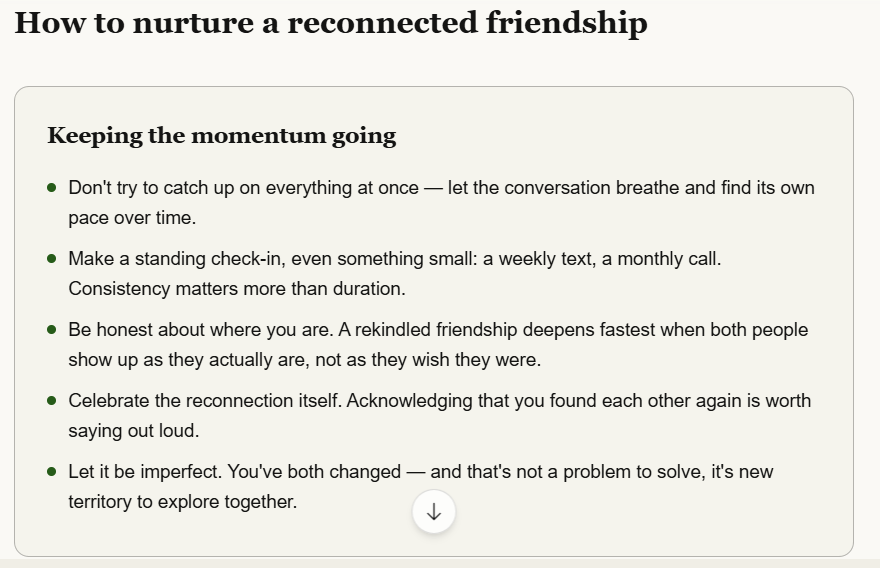
Reaching back out after years apart takes courage. There’s vulnerability in it — a quiet fear that too much time has passed, that you’ll be strangers now. But more often than not, the first real conversation cuts right through that fear. The familiarity rushes back. And what follows is something that feels less like catching up and more like coming home.
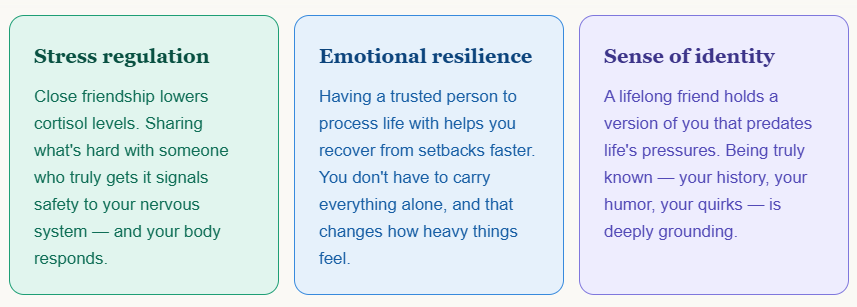
When we reconnect with someone we’ve been close to, the brain responds in ways that go beyond ordinary social interaction. Being seen by someone who has known you across time activates a sense of continuity and self-coherence — particularly valuable during periods of stress or transition, when identity can feel uncertain.
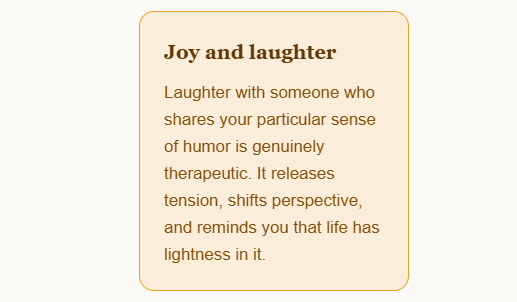
There’s also the specific comfort of shared memory. Laughing about something that happened fifteen years ago isn’t just nostalgia — it’s a reminder that you have a story, a thread of meaning that runs through your life regardless of what’s hard right now.
And practically speaking, a restored friendship gives you someone to call. Not just in crisis, but on an ordinary afternoon when something is weighing on you and you need to hear a voice that already knows you. That access is a genuine, measurable buffer against chronic stress.

There is a particular kind of peace that settles in when you’ve spent time with someone who has known you across the years — someone who remembers who you were before life got complicated, and who sees who you are now without needing an explanation. That peace is real, and it does something measurable for your nervous system, your mood, and your sense of being held in the world.
If there’s someone in your life you’ve lost touch with — a friend you think about, someone whose name comes up in your memory more than you’d expect — maybe that quiet pull is worth listening to. A simple message. A few words. The door doesn’t have to be wide open to let the light back in.
Sometimes the most wellness-forward thing you can do is just reach out and say: I’ve been thinking about you. How are you?

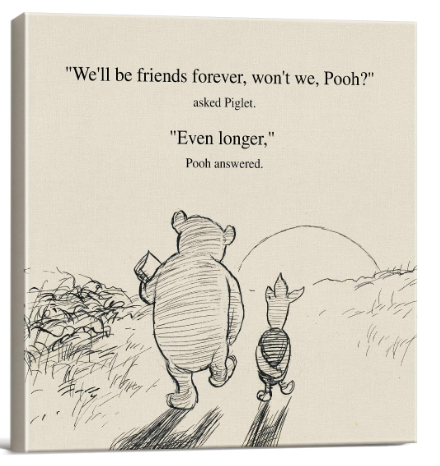
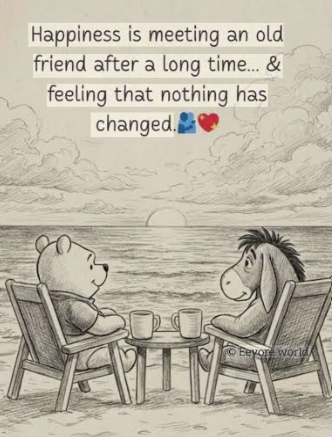
The best friendships don’t expire. They just wait — patiently, faithfully — for the right moment to begin again.
So glad to be in touch again Sue!
The colors we reach for say more than we realize — and intentional color choice can become one of the most powerful tools in emotional healing.

Have you ever felt instantly calmer stepping into a room painted soft sage green? Or noticed a surge of energy when you wore something bright red? Color is rarely neutral. It speaks to something primal in us — influencing mood, memory, and meaning long before we find the words to describe what we’re feeling.
Art therapy takes this intuition seriously. Rather than treating color as decoration, it treats color as communication — a language available to everyone, regardless of artistic skill.

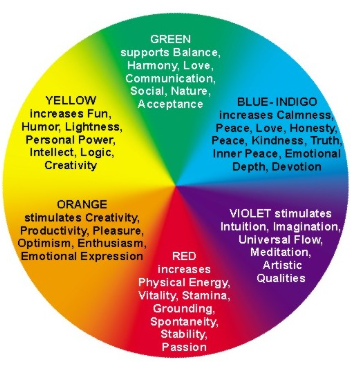
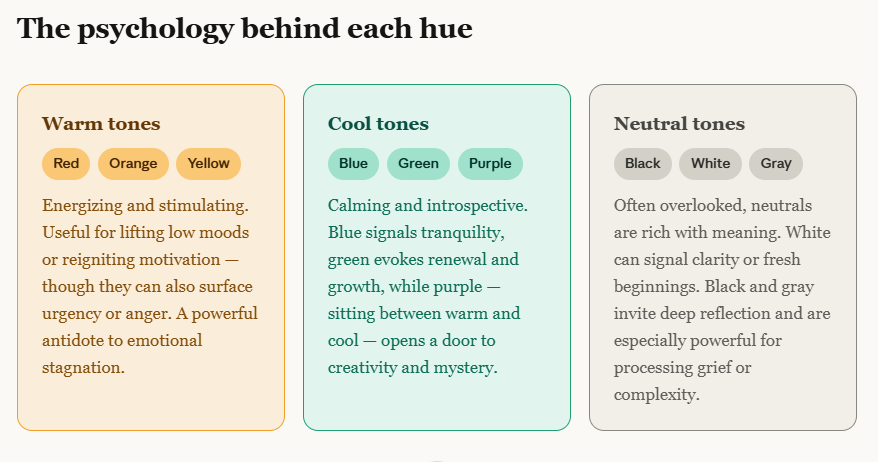
The color wheel of emotions is a framework rooted in psychology that pairs colors with specific emotional states. Think of it as an emotional vocabulary for those moments when feelings are present but words aren’t. Red might surface as passion or frustration. A deep, quiet blue might represent the particular heaviness of grief — or the open spaciousness of peace. The same color can hold opposing truths, which is part of what makes working with it so revealing.
In art therapy settings, this framework helps people externalize what’s internal — giving visible form to experiences that might otherwise stay locked inside.

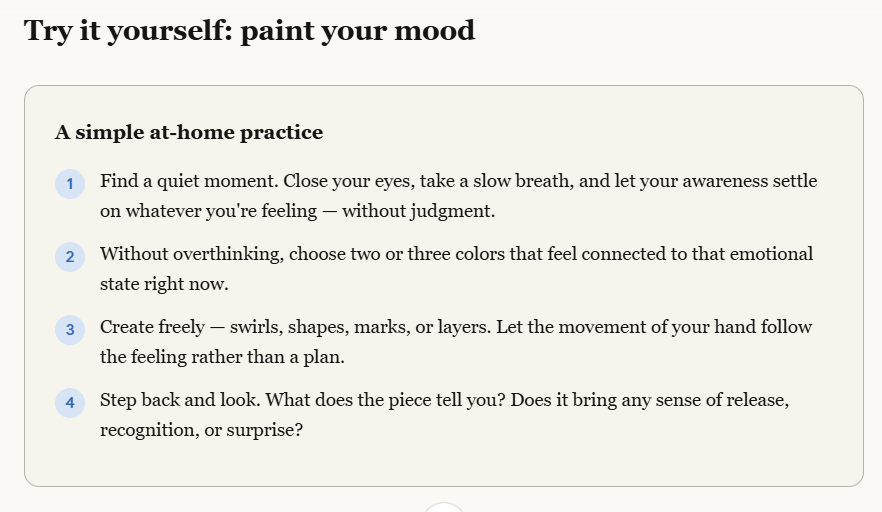
In a session, a therapist might invite a client to choose colors that feel true to what they’re experiencing right now — not what looks good, but what feels honest. Someone moving through anxiety may find themselves drawn to blues and greens without quite knowing why. Someone who feels emotionally stuck might instinctively reach for vivid yellows and oranges.
The act of choosing is itself meaningful. And what emerges on the canvas — the weight of a brushstroke, the way colors bleed into each other, the parts left blank — often reveals more than verbal reflection alone could uncover.
A useful question to sit with during this process: Why does this color feel right today? Or: What does this shade remind me of? You might be surprised what comes up.

There’s no right outcome here. The goal isn’t a finished painting — it’s a moment of honest contact with yourself, expressed in color rather than words.
What art therapy reminds us is that color is never just pigment. It carries memory, emotion, and meaning that words can miss entirely. Whether you’re processing something heavy or simply exploring how you feel on an ordinary Tuesday, picking up a brush and letting color speak can be quietly transformative.
You don’t need to be an artist. You just need to be willing to look at what you reach for — and ask yourself why.
Every shade has something to say. The question is whether we’re listening.
Most of the stress we carry each day doesn’t come from what actually happens.
It comes from the meaning we attach to it.
A message goes unanswered.
A glance lingers a second too long.
A simple “Can we talk tomorrow?” lands in your inbox.
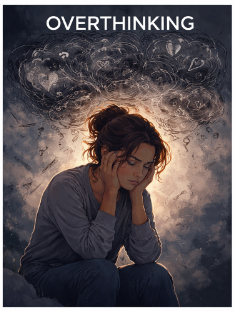
And just like that, your mind gets to work—fast, creative, and often completely unverified.
You don’t just notice the moment.
You interpret it.
And more often than not, your interpretation leans negative.

Humans are wired to make sense of things quickly. When we don’t have all the information, our brains step in to complete the story.
The problem?
They tend to default to the worst-case version.
But here’s the truth:
Most of the time, we don’t actually know what’s going on.
We’re reacting—not to reality—but to a story we created in its absence.
What if we interrupted that pattern?
What if, instead of assuming the worst… we chose a kinder explanation?
This isn’t about denying reality or pretending everything is perfect.
It’s about recognizing that when you don’t have the facts, you have a choice.
And choosing a harsh story only makes your experience heavier.
Choosing a kinder one makes it lighter.
This is the part most people miss:
When the truth is unknown, your interpretation is optional.
You’re not obligated to believe the first thought that shows up.
You can pause.
You can question it.
You can replace it.
Because the story you choose doesn’t just explain your world—it shapes how you feel inside it.

Try this today.
Just once… or maybe a few times.
Give someone the benefit of the doubt—for ten seconds.
That’s it.
When something feels off:
A short reply.
A missed message.
A tone you didn’t expect.
Before your mind rushes in with its usual explanation, pause.
And consider something softer:
Your brain is already good at creating stories.
For ten seconds, ask it to create a better one.
You don’t have to fully believe it.
You don’t have to commit to it forever.
Just let it exist.
That tiny pause can change everything.
It can:
Because when you stop assuming the worst, you stop reacting to things that may not even be real.
And that’s powerful.
Life is full of unknowns.
People are complicated. Moments are incomplete. Communication is imperfect.
But in the space where certainty is missing…
Kindness is always an option.
Especially toward yourself.
So the next time your mind fills in the blanks, remember:
You don’t have to go with its first draft.
You can choose a better story.
And sometimes, that small choice is enough to change your entire day.

Ask a room full of kids what they want to be when they grow up and brace yourself.
You’ll hear things like: marine biologist, famous painter, and bakery owner — all from the same child, all in the same breath, delivered with the kind of confidence that makes you wonder when exactly the rest of us lost ours.
One kid wants to build robots and play professional soccer and also be a firefighter. Somehow simultaneously. He hasn’t figured out the schedule yet. He is not worried about the schedule.
And that’s exactly the point.
Kids don’t dream in limitations.
They don’t start with is this realistic? They don’t wonder if someone who looks like them has done it before. They don’t quietly talk themselves out of something before they’ve even said it out loud. They just… go. Full speed. No filter. No apology.
There’s no committee in their head voting on whether the dream is practical enough to mention.
So what happens?
Somewhere between childhood and adulthood, most of us learn to shrink.
It doesn’t happen in one dramatic moment. It’s a slow accumulation — a raised eyebrow from someone whose opinion mattered, a “be realistic” from a well-meaning adult, a dream that didn’t pan out the way we hoped. A few of those experiences and we start to learn: wanting too much is risky.
So we adjust. We edit. We filter our dreams through a lens of what seems reasonable, what’s been done before, what other people are likely to approve of.
We start choosing safe over alive.
We aim for things that look good on paper — even when they don’t feel that good on the inside.
We learn to call that maturity. Sometimes it is. But sometimes it’s just fear wearing a responsible-sounding disguise.
The problem isn’t that we grew up. It’s that we stopped growing outward.
There’s a real difference between wisdom and self-limitation. Wisdom helps you move forward thoughtfully. Self-limitation just keeps you stuck in place, calling it caution.
Kids aren’t wiser than adults — but they haven’t yet learned to be afraid of their own imagination. They haven’t been taught that dreaming big is something to be embarrassed about. They haven’t internalized the idea that wanting more than what you have is somehow ungrateful or unrealistic.
They just know what lights them up. And they say it.
Out loud. Without shrinking.
What would change if you did the same?
Not in a reckless, throw-everything-out way. But genuinely — what would shift if you stopped editing yourself before you even got started? If you let yourself want something without immediately running it through the filter of what will people think or has anyone like me done this before or what if I fail?
Here’s the truth: those questions will always be there. They don’t go away just because you decide to dream bigger. But they don’t have to be the first voice in the room either.
The kids aren’t fearless because they don’t understand risk. They’re free because they haven’t yet decided that their dreams need to be approved before they’re worth having.
Reclaiming that freedom as an adult looks different — but it’s still possible.
It starts with noticing the places where you’ve been quietly playing small. The ideas you’ve brushed off before fully exploring them. The things you want that you’ve stopped letting yourself say out loud because they felt too big or too different or too hard to explain to other people.
It means getting honest about the difference between I’ve thought this through and it’s not for me and I’m afraid, so I’m pretending I don’t want it.
It means being willing to sound a little like a kid at dinner again — unfiltered, unedited, unconcerned with whether the dream makes perfect sense yet.
The marine biologist slash painter slash bakery owner doesn’t need her plan to be airtight to know what excites her.
Maybe you don’t either.
Stop shrinking. Start there.
Understanding Triggers, Not Just Words

Have you ever walked away from a conversation feeling completely misunderstood?
You chose your words carefully.
You stayed calm.
You tried to explain yourself clearly.
And somehow… it still turned into conflict.
What you said wasn’t what they heard.
The truth is, not everyone listens with open ears.
Some people listen through their pain.
When someone is unhealed, their past doesn’t stay in the past—it shows up in the present moment, quietly shaping how they interpret everything around them.
So instead of hearing your intention, they hear something else entirely:
It’s not that your words are wrong.
It’s that their wounds are loud.
One of the hardest things to recognize is this:
You’re trying to have a conversation in the present,
but they’re reacting from the past.
Something you said may have brushed against an old hurt—one that has nothing to do with you, but everything to do with what they’ve experienced before.
And in that moment, they’re no longer responding to you.
They’re responding to:
Their reaction may feel confusing, exaggerated, or even unfair.
But to them, it feels real.
Because pain has a way of rewriting the moment.
You can be calm.
You can be kind.
You can be careful.
And still be misunderstood.
Because when someone is triggered, their nervous system is in protection mode—not connection mode.
They’re not asking, “What did you mean?”
They’re reacting to “What does this remind me of?”
And in those moments, even the softest words can feel sharp.
Understanding this doesn’t mean accepting hurtful behavior.
It doesn’t mean walking on eggshells or shrinking yourself to avoid someone else’s triggers.
But it does give you clarity.
It helps you realize:
Sometimes, the issue isn’t communication.
It’s unhealed pain.
We often think of healing as something personal—something we do quietly, on our own time.
But healing directly impacts how we love, how we listen, and how we connect.
Without it:
Healing allows us to pause before reacting.
To hear what’s actually being said—not just what we fear is being said.
To stay present instead of slipping into old stories.
If you find yourself constantly misunderstood by someone, it can be exhausting.
You may start to:
Here’s something important to hold onto:
You are not responsible for healing wounds you didn’t create.
You can be compassionate.
You can be patient.
But you cannot do the healing for someone else.
And no matter how gently you speak, you cannot out-whisper someone else’s pain.
Sometimes the most powerful shift is this:
Instead of asking, “Why don’t they understand me?”
you begin to ask, “What might they be carrying?”
Not to excuse behavior—but to understand it.
And with that understanding, you can decide:
Because healthy connection requires two people who are willing—not just to speak—but to hear.
We all have wounds.
We’ve all, at some point, reacted from a place that had nothing to do with the moment we were in.
So this isn’t about labeling others.
It’s about awareness.
The more we heal, the more clearly we hear.
The more clearly we hear, the more deeply we connect.
And that’s what makes healing so important.
Not just for ourselves—
But for every relationship we want to keep.
Why learning to be bored might be the most radical thing you do this year.
5 min read Originally published March 2026
Picture this: you’re deep in the middle of something — a project, an article, a train of thought that was actually going somewhere. Then, without any warning or real reason, your hand moves to your phone. Not because something urgent happened. Not because you needed information. Just… because.
Sound familiar? Here’s the thing most people don’t realize: that moment wasn’t a failure of willpower. It was your nervous system doing exactly what it was built to do — hunting for a reward.

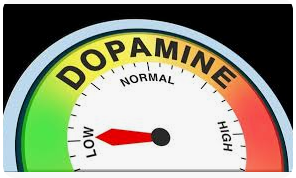
Our brains are wired to seek stimulation. When a task stops feeling interesting or rewarding, dopamine levels quietly dip. And the moment that happens, the brain starts sending out urgent requests: find me something. A notification. A headline. A thirty-second video about absolutely nothing. It doesn’t really matter what — as long as it delivers a quick signal that something is happening.
The problem isn’t that we occasionally get distracted. It’s that we’ve built entire systems — apps, platforms, feeds — specifically designed to feed that hunger on a loop. Which means we’re rarely ever actually bored anymore. And that’s a much bigger issue than it sounds.
“We’ve built an entire world designed to make sure you never have to sit with your own thoughts for more than fifteen seconds.”
Here’s the counterintuitive truth: boredom is actually useful. When your mind isn’t occupied with input, it starts doing something remarkable on its own. It wanders. It connects dots. It surfaces questions and ideas and feelings that haven’t had room to breathe. Some of your best thinking — your clearest decisions, your most creative ideas — lives on the other side of boredom.
But you’ll never get there if the moment any quiet opens up, you fill it. Every time you reach for the phone to avoid a dull moment, you’re essentially telling your brain: silence is dangerous, stillness is something to escape. Over time, that message sticks.

There’s a reason people describe silence as “deafening.” When all the noise stops, what fills the space isn’t peace — at least not at first. It’s everything you’ve been too busy to deal with. The awkward conversation you replayed a hundred times. The goal you keep putting off. The quiet truth you’ve been carefully avoiding.
We scroll past these things a dozen times a day. But when the screen goes dark and the room goes quiet, they’re still there. Waiting.
This is why stillness can feel more like a confrontation than a rest. And it’s also why it matters so much. That discomfort isn’t a sign that something is wrong — it’s a sign that your mind is finally getting a chance to process instead of just react.
Try this today
Set a timer for just ten seconds. Find a blank wall — not a window, not your phone, not the room’s most interesting corner. Stare at it. Do absolutely nothing. Notice what your brain does when you don’t hand it something to chew on. That’s where it starts.
You don’t have to go off-grid to reclaim your attention. Start with one app — the one you reach for most automatically, the one you open without deciding to. Delete it for just 24 hours. Not to be productive. Not as some kind of punishment. Just to see what happens when that particular exit door is closed.
You’ll probably feel restless at first. Maybe even irritable. That reaction itself is worth paying attention to — it tells you how much mental real estate that app has been quietly occupying.
But something else tends to happen too. Small windows of time reappear. Thoughts start completing themselves instead of getting interrupted. You remember that your inner voice actually has things to say, once you stop talking over it with content.
This isn’t about willpower or going on a digital detox retreat. It’s about reclaiming tiny moments — the five seconds at a red light, the two minutes before a meeting, the space between one task and the next — and letting them be what they are: nothing. Just you and your brain, without an agenda.
The most interesting ideas don’t usually arrive while you’re consuming something. They arrive in the gaps. In the shower. On a slow walk. In the moment after you close the laptop and haven’t opened anything else yet.
Those moments are not wasted time. They’re the conditions your mind needs to actually think — not just process input, but generate something original. When you protect even a little of that space, you’re not opting out of life. You’re opting back in to the parts of it that are actually yours.
So maybe the most rebellious thing you can do in an age of infinite content isn’t to find better content. It’s to need less of it. To tolerate a little quiet. To let boredom show you what’s underneath.
You might be surprised what’s been waiting there all along.

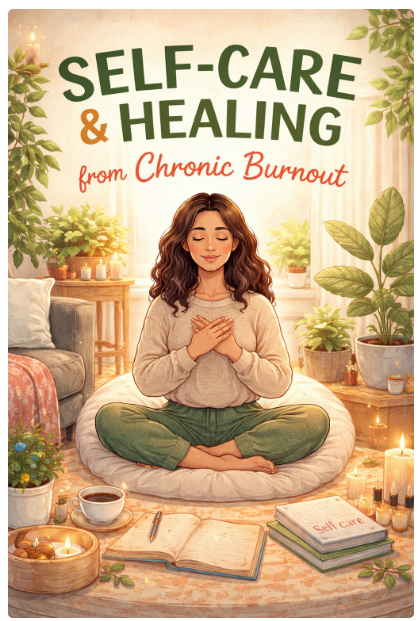
A gentle guide for those who have been running on empty for far too long.
If you’re reading this, you’re probably exhausted in a way that a good night’s sleep stopped fixing a long time ago. Maybe you’ve been going through the motions for months — or years — just trying to get through each day. Maybe you can’t remember the last time something felt easy, or light, or genuinely yours.
That’s burnout. And more specifically, that’s what it looks like when burnout has been going on long enough that survival mode isn’t an emergency response anymore — it’s just become how you live.
The fact that you’re asking how to heal is already meaningful. Here’s what that healing can look like — gently, slowly, and on your own terms.
Prolonged survival mode keeps your body flooded with stress hormones. Over time, your nervous system literally learns that rest is unsafe — that slowing down is a threat. So before anything else, know this: your exhaustion, your numbness, your inability to relax isn’t a personal failing. It’s a physiological adaptation.
Healing means slowly, patiently teaching your body that safety is real again. That takes time. Be patient with yourself.

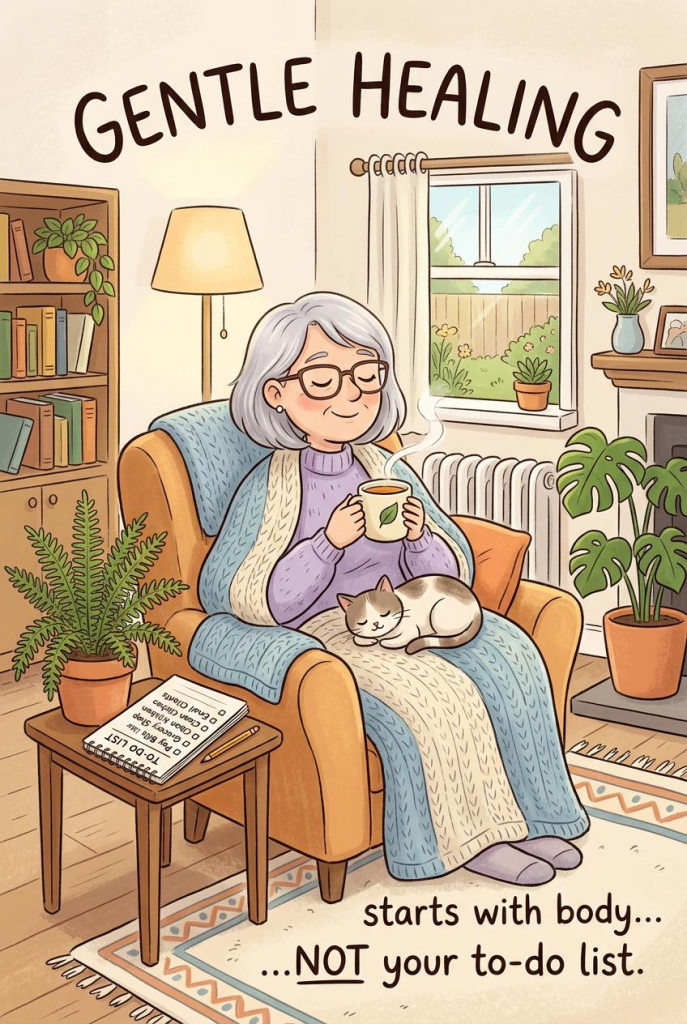
When we’re burned out, the instinct is often to think our way out of it — to plan, to restructure, to optimise. But healing begins in the body, not the mind. Some gentle starting points:
When you’re chronically depleted, doing “normal” things takes enormous effort. Cooking a meal, replying to a message, getting dressed — these can feel monumental. And that’s okay. It doesn’t mean something is deeply wrong with you. It means you’re running on fumes and your system needs a break.
Give yourself permission to do less than you think you should. The version of “enough” that kept you in survival mode this long clearly wasn’t working. It’s time to try a different standard.

Burnout often disconnects you from joy. Not just the big joys — the small ones too. You stop noticing what feels good, because for so long, nothing really has.
You don’t need to chase happiness. Just start noticing tiny things that feel even slightly good — a warm drink, sunlight on your face, a song that moves something in you. These small signals of aliveness are how you begin to reconnect with yourself. Don’t underestimate them.
Burnout rarely exists in isolation. Underneath it, there’s usually grief, resentment, unmet needs, or things you sacrificed along the way that were never properly acknowledged.
Journaling, therapy, or even just quietly sitting with “this was really hard” can be surprisingly healing. You don’t need to fix everything. Sometimes just naming it — giving it language — releases something.
Recovery requires reducing what’s draining you, even if only slightly. You don’t have to overhaul your entire life overnight. But it helps to honestly notice: what costs you the most? And is any of it negotiable, even just by 10%?
Setting limits isn’t selfish. It’s how you stop the bleeding. And it’s something you may need to practice doing gently, without guilt, over and over again.
This might be the most important thing: the instinct after burnout is often to fix yourself fast and get back to performing. That’s survival mode talking. That’s the same voice that got you here.
Real healing doesn’t follow a schedule. Some weeks you’ll feel better. Others, you’ll feel like you’ve gone backwards. That’s not failure — that’s what non-linear recovery looks like. The goal isn’t to be fixed. The goal is to slowly, gradually, feel more like yourself again.
A few final thoughts:
You deserve to move out of survival and into actually living. Be patient with yourself — you’ve been fighting for a long time.

The way we work has changed forever. More people than ever are ditching the daily commute, trading in their office cubicles, and building careers from the comfort of their own homes. But if you’ve ever searched for remote work opportunities online, you’ve probably noticed the same two categories dominating every list — IT jobs and video editing. And while those are great options for some, they’re certainly not for everyone.
The good news? You don’t need to know how to code or sit behind a editing timeline to thrive in the remote work world. There is an enormous and growing market for remote professionals across nearly every industry imaginable — from healthcare and finance to education, creative arts, and beyond.
Whether you’re a stay-at-home parent looking to re-enter the workforce, someone tired of the 9-to-5 grind, or simply searching for a career change that offers more flexibility, this list was made for you. We’ve put together 100 legitimate work from home jobs that have absolutely nothing to do with IT or video editing, covering a wide range of skill sets, experience levels, and industries.
So grab a coffee, get comfortable, and let’s explore the remote career that could be waiting for you.
Here are 100 work from home jobs that have nothing to do with IT:
Writing & Editorial
1. Freelance writer
2. Copywriter
3. Content strategist
4. Blog writer
5. Grant writer
6. Technical writer (non-IT)
7. Ghostwriter
8. Proofreader
9. Copy editor
10. Resume writer
Education & Coaching
11. Online tutor
12. Curriculum developer
13. E-learning course creator
14. Language teacher (ESL, etc.)
15. Life coach
16. Career coach
17. Academic advisor
18. Test prep instructor
19. Homeschool educator
20. Music teacher (virtual lessons)
Administrative & Business Support
21. Virtual assistant
22. Data entry specialist
23. Online research assistant
24. Executive assistant
25. Scheduling coordinator
26. Transcriptionist
27. Bookkeeper
28. Billing specialist
29. Payroll administrator
30. Document reviewer
Sales & Marketing
31. Social media manager
32. Email marketing specialist
33. Affiliate marketer
34. Brand ambassador
35. Market research analyst
36. SEO content writer
37. Advertising copywriter
38. Public relations specialist
39. Lead generation specialist
40. Sales representative
Finance & Accounting
41. Accountant
42. Tax preparer
43. Financial analyst
44. Budget consultant
45. Insurance agent
46. Mortgage loan officer
47. Financial planner
48. Auditor
49. Accounts payable/receivable clerk
50. Cryptocurrency trader
Healthcare & Wellness
51. Telehealth nurse
52. Medical coder
53. Medical biller
54. Health coach
55. Nutritionist/dietitian
56. Mental health therapist (telehealth)
57. Medical transcriptionist
58. Pharmacy technician (remote roles)
59. Health insurance specialist
60. Yoga/fitness instructor (virtual)
Creative & Design
61. Graphic designer
62. Illustrator
63. Animator
64. UX/UI designer
65. Logo designer
66. Photo editor
67. Stock photographer
68. Podcast producer
69. Voice-over artist
70. Audiobook narrator
Legal & Compliance
71. Paralegal
72. Legal transcriptionist
73. Contract reviewer
74. Compliance officer
75. Legal researcher
76. Court reporter (remote)
77. Immigration consultant
78. Intellectual property specialist
79. Claims adjuster
80. HR compliance specialist
Customer Service
81. Customer service representative
82. Chat support agent
83. Call center agent
84. Customer success manager
85. Complaint resolution specialist
86. Order fulfillment coordinator
87. Client onboarding specialist
88. Community manager
89. Help desk support (non-IT)
90. Retention specialist
Miscellaneous
91. Travel agent
92. Event planner (virtual events)
93. Real estate agent (remote-friendly)
94. Translator/interpreter
95. Survey taker/researcher
96. Recruiter/headhunter
97. E-commerce seller (Etsy, eBay, Amazon)
98. Mystery shopper (online)
99. Closed captioning specialist
100. Online juror (mock trial participant)
These span a wide range of skill levels and industries, so there’s something for almost everyone
The Bottom Line
The traditional 9-to-5 office job is no longer the only path to a successful and fulfilling career. The remote work revolution has completely changed the game, and the opportunities available today didn’t even exist a decade ago. Whether you’re a complete beginner or a seasoned professional looking for a change, there is something on this list for you.
The hardest part isn’t finding the opportunity — it’s taking that very first step. So don’t let fear or uncertainty hold you back from the flexibility and freedom that a work from home career can offer.
Getting Started
The key to getting started is to keep it simple. Look back through the list and pick one or two jobs that align with the skills you already have. You don’t need to reinvent yourself overnight. Start where you are, with what you know, and build from there. Update your resume to reflect the qualities that remote employers love most — things like self-motivation, strong written communication, and the ability to manage your own time. If you don’t have a LinkedIn profile yet, now is the perfect time to create one.
Staying Consistent
Once you start applying, treat your job search like a job itself. Set a routine, create daily goals, and stick to them. Set up a dedicated workspace in your home so your brain knows when it’s time to focus. And above all else, be patient with yourself. Landing your first remote role can take time, but the people who stay consistent are always the ones who get there.
Where to Find Legitimate Remote Work
When it comes to finding remote jobs, stick to reputable platforms like FlexJobs, Remote.co, We Work Remotely, and LinkedIn. These sites vet their listings and make it much easier to find real opportunities. One important word of warning — always be cautious of scams. A legitimate remote job will never ask you to pay a fee upfront or send you a check before you’ve even started working. If something feels off, trust your gut.
Final Thoughts
Your dream career doesn’t have to come with a commute, a dress code, or a boss hovering over your shoulder. The remote work world is wide open and waiting for people just like you. Take this list, find your fit, and go after it with everything you have.
The only move you’ll regret is the one you never made.