Protect Your Peace
04
Oct
2026
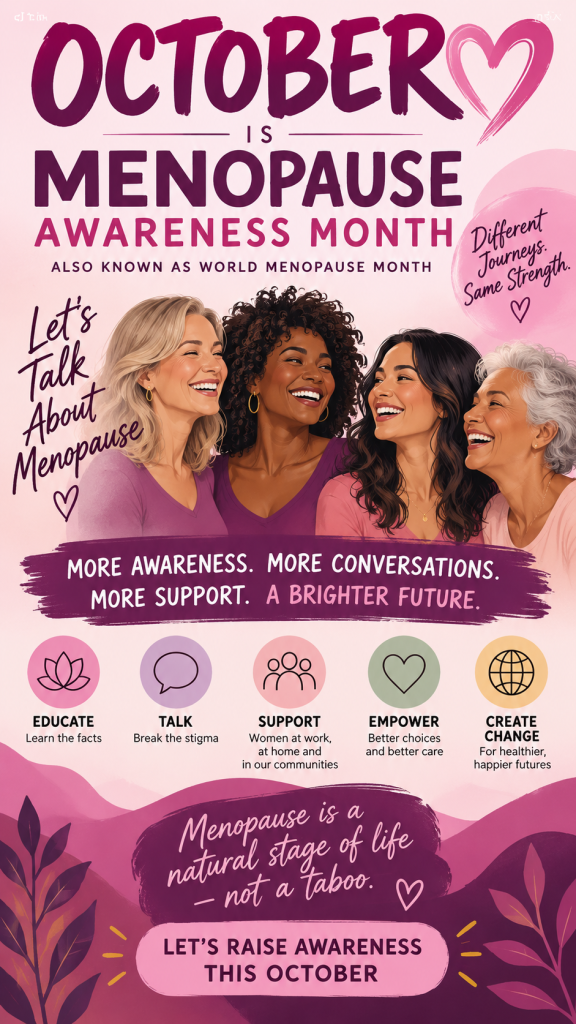
Empower yourself, reclaim your strength, and find freedom through your menopause journey.
October is Menopause Awareness Month—a time to open the conversation about a stage of life that millions of women experience, yet one that has been misunderstood, minimized, or simply not talked about enough.
For generations, menopause was often treated as something women were expected to quietly endure. Hot flashes, sleepless nights, changes in mood, brain fog, fatigue, changes in our bodies—and sometimes changes in the way we see ourselves—were brushed aside as simply part of getting older.
But menopause deserves a much bigger conversation.
Menopause isn’t an ending. It is a transition into a new chapter of life.
And transitions can be messy.
There may be days when you don’t quite recognize yourself. Your patience may be shorter. Your emotions may feel closer to the surface. Sleep can become unpredictable, and stress that you once handled easily may suddenly feel overwhelming.
That doesn’t mean you’ve lost your strength.
It may simply mean it’s time to start listening to yourself differently.
Instead of asking, “Why can’t I handle things the way I used to?” we can begin asking, “What do I need now?”
That small shift can be incredibly powerful.
Menopause can be an invitation to become more intentional about caring for ourselves.
That might mean nourishing our bodies with foods that help us feel our best, finding movement we actually enjoy, protecting our sleep, learning ways to manage stress, talking openly with healthcare professionals about symptoms and treatment options, or simply giving ourselves permission to rest without feeling guilty.
It can also mean recognizing that self-care isn’t selfish.
Sometimes self-care is five quiet minutes before everyone else wakes up.
Sometimes it’s taking a walk.
Sometimes it’s saying no.
Sometimes it’s making an appointment and asking questions about symptoms you’ve been ignoring.
And sometimes it’s sitting quietly, taking a slow breath, and reminding yourself: I am allowed to take care of me, too.
One of the most important things we can do during Menopause Awareness Month is simply talk about it.
When women share their experiences, other women realize they aren’t alone.
When workplaces understand menopause, conversations about women’s health become easier.
When families understand what may be happening physically and emotionally, there can be greater compassion.
And when we educate ourselves, we are better prepared to advocate for our own health and well-being.
Menopause shouldn’t be whispered about.
Growing older doesn’t make our stories smaller.
In many ways, they become richer.
We’ve learned what matters and what doesn’t. We’ve survived things we once thought we couldn’t. We’ve loved, lost, changed, started over, and discovered strengths we didn’t know we had.
Menopause becomes another part of that story.
It can be a time to reconnect with ourselves—not the person everyone else expects us to be, but the person we are becoming.
So this October, during Menopause Awareness Month, let’s replace silence with conversation, judgment with compassion, and fear with knowledge.
Let’s support one another.
Let’s ask questions.
Let’s listen to our bodies.
Let’s make our well-being a priority.
And most importantly, let’s remember:
This isn’t the end of who you were. It may be the beginning of discovering who you are now.
Take a breath. Give yourself grace. You are allowed to change.
Breathing Room with Rita Long
Creating space to breathe, reset, and reconnect with yourself.
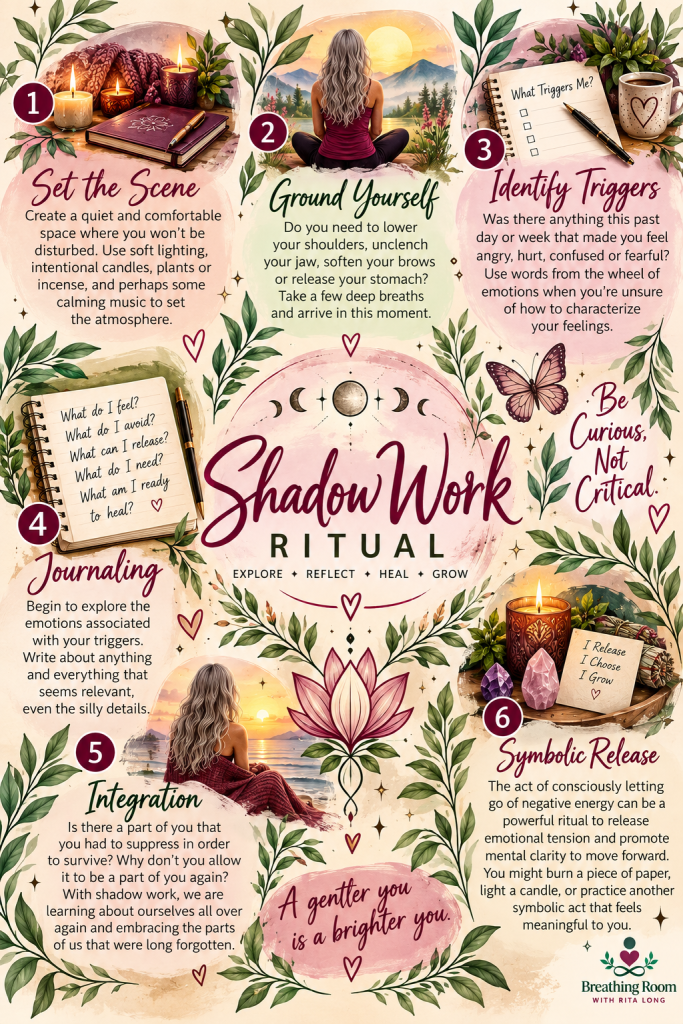
There are parts of ourselves that we readily share with the world—and then there are the parts we keep tucked away.
Maybe it’s anger we were taught wasn’t acceptable. Perhaps it’s jealousy, fear, insecurity, resentment, or even dreams and desires we’ve convinced ourselves we shouldn’t have. Sometimes these hidden pieces are so deeply buried that we barely recognize them as part of ourselves.
This is where shadow work comes in.
The idea of the “shadow” is commonly associated with psychologist Carl Jung, who used the term to describe aspects of ourselves that exist outside our everyday conscious awareness. Shadow work is the practice of becoming curious about these hidden or rejected parts of ourselves rather than simply pushing them away.
The purpose isn’t to judge yourself or dig up painful memories just for the sake of revisiting them. It’s about developing greater awareness of what influences your reactions, choices, relationships, and emotional patterns.
Sometimes the things we discover in our shadows aren’t “bad” at all. They may simply be pieces of ourselves we learned to hide.
Have you ever had a reaction that seemed much stronger than the situation called for?
Maybe someone’s behavior irritated you far more than you expected. Perhaps the same type of relationship problem keeps appearing in your life. Or maybe you find yourself repeating a behavior even though you consciously want to change it.
Instead of immediately criticizing yourself, shadow work invites you to become curious.
Why did that affect me so strongly?
What am I protecting?
What does this remind me of?
Is there something underneath this reaction that needs my attention?
That curiosity can create space between simply reacting and beginning to understand yourself.
A ritual doesn’t need to be complicated or mystical. At its simplest, a ritual is intentional time that you set aside for yourself.
Choose a quiet place where you feel comfortable and are unlikely to be interrupted. You might dim the lights, play soft instrumental music, light a candle, or simply sit somewhere peaceful.
Bring a journal and pen. If meaningful objects such as crystals, tarot or affirmation cards help you feel reflective, you can include them too. They aren’t necessary for shadow work—the important part is creating an environment where you feel comfortable being honest with yourself.
Before beginning, decide what you would like to explore.
Your intention might be:
“I want to understand why this situation keeps upsetting me.”
“I want to explore why I have difficulty setting boundaries.”
“I want to understand a pattern I keep repeating.”
You don’t have to solve everything in one sitting. One question is enough.
Before turning inward, spend a few moments settling your body and mind.
Place your feet comfortably on the floor. Relax your shoulders. Take several slow, comfortable breaths and notice the physical sensations around you—the chair supporting you, the temperature of the room, or the sounds you can hear.
You aren’t trying to force yourself into a particular emotional state. You’re simply giving yourself a moment to arrive.
When you feel ready, open your journal.
Shadow work isn’t about finding the “correct” answer. Allow yourself to write without worrying about grammar, spelling, or whether your thoughts make perfect sense.
You might begin with questions such as:
What qualities in other people tend to trigger or irritate me? Why might those qualities affect me so strongly?
What feelings do I have difficulty admitting or expressing?
What parts of myself do I try hardest to hide from other people?
When have I behaved in a way that didn’t match my values? What was happening beneath the surface at the time?
What am I afraid people would think about me if they knew everything I thought or felt?
What did I learn growing up about which emotions were acceptable and which weren’t?
Where in my life am I pretending that something doesn’t bother me when it actually does?
Don’t rush to explain, justify, or fix what appears on the page.
Notice it.
Sometimes awareness itself is the first meaningful change.
Shadow work can bring up emotions we would rather avoid.
If anger appears, notice it.
If sadness appears, acknowledge it.
If embarrassment, jealousy, fear, resentment, or insecurity surfaces, try approaching it with curiosity instead of immediately labeling it as good or bad.
You can ask yourself:
“What might this feeling be trying to tell me?”
An emotion does not automatically define your character, and acknowledging a feeling does not mean you must act on it. It simply means you are allowing yourself to recognize what is present.
And remember—you control the pace.
If reflection begins to feel overwhelming, you can stop. Shadow work isn’t a test of how deeply you can push yourself in one sitting.
Rather than abruptly returning to your day, give yourself a clear ending.
You might close your journal and take several slow breaths. You could light a candle as a symbol of greater awareness or write down one belief, habit, or thought you’re ready to begin releasing.
If you enjoy symbolic rituals, you might tear up that piece of paper or place it somewhere private as a reminder of what you’re working toward. If you choose to burn paper or use candles, use ordinary fire-safety precautions and adult supervision where appropriate.
Then ask yourself one final question:
“What do I understand about myself now that I didn’t understand before?”
You don’t need a profound answer every time.
Sometimes the answer is simply, “I need to think about this some more.”
That counts too.
Deep reflection can be emotionally tiring, so don’t immediately expect yourself to jump back into everything at full speed.
Drink some water. Stretch. Step outside. Take a walk. Listen to music. Sit quietly for a few minutes. Do something that helps you reconnect with the present moment.
You may even want to revisit your journal a few days later. With a little distance, you might notice patterns or connections that weren’t obvious when you first wrote them.
The goal of shadow work isn’t to eliminate every uncomfortable thought or emotion.
It’s to know yourself more completely.
Every person contains contradictions. We can be loving and angry. Confident and insecure. Generous and jealous. Brave and frightened. Understanding these different parts of ourselves gives us more opportunity to decide how we want to respond rather than allowing unconscious patterns to make those decisions for us.
Approached gently, shadow work can become less about asking, “What’s wrong with me?” and more about asking:
“What is this part of me trying to teach me?”
And sometimes that single change in perspective can open the door to greater self-awareness, compassion, and growth.
Take what feels helpful, move at your own pace, and remember that personal reflection doesn’t have to happen all at once. Some parts of ourselves are understood slowly—and that’s okay.
There is something about looking up at the Moon that has a way of making us pause.
Perhaps it’s because the Moon has been there through generations of human stories, celebrations, grief, beginnings, endings, and ordinary nights when someone simply needed a little quiet.
On the night of August 27 into August 28, 2026, the Moon will move through Earth’s shadow during a deep partial lunar eclipse.
NASA classifies this as a partial lunar eclipse. At its greatest point, approximately 96.3% of the Moon’s disk will be within Earth’s darkest shadow, called the umbra. The eclipse will be visible across much of the Americas, as well as parts of Europe and Africa.
The shadowed portion of the Moon can take on a beautiful coppery or reddish appearance. This happens because sunlight passing through Earth’s atmosphere is scattered in a way that allows more red and orange wavelengths to reach the Moon.
It is a completely natural astronomical event.
But that doesn’t mean we can’t find personal meaning in watching it.
Moving Through the Shadow
There is something deeply symbolic about a Moon moving through darkness and then continuing on its way.
We all have seasons when life feels a little darker.
Sometimes we’re grieving something.
Sometimes we’re beginning again.
Sometimes we’re simply exhausted from carrying things that we’ve carried for too long.
And sometimes we don’t even know exactly what we’re feeling.
We just know that something inside of us is asking for change.
An eclipse can become a beautiful opportunity to pause—not because the eclipse has magical control over our lives, but because we can choose to use this moment as a reminder.
A reminder to breathe.
A reminder to reflect.
A reminder that being in a shadow is not the same thing as being lost.

What Are You Ready to Release?
You might sit beneath the Moon for a few minutes and ask yourself:
What am I carrying that I don’t need to carry into my next chapter?
Don’t judge the answer.
Maybe it’s resentment.
Maybe it’s fear.
Maybe it’s an old version of yourself.
Maybe it’s the belief that you aren’t capable of beginning again.
Maybe it’s simply the pressure to have everything figured out.
You don’t have to release everything tonight.
Sometimes awareness is enough.
Sometimes the first step isn’t letting go.
It’s simply saying:
“I know you’re there.”
And then breathing.
Your Light Hasn’t Disappeared
One of my favorite things about the eclipse is the reminder that darkness doesn’t mean disappearance.
The Moon is still there even when Earth’s shadow covers much of it.
And perhaps we can borrow that image for ourselves.
There may be seasons when you don’t feel like yourself.
There may be times when your confidence is quiet.
There may be moments when you wonder whether the person you used to be is still somewhere inside you.
She may be.
But perhaps you’re not meant to go backward.
Perhaps you’re becoming someone new.
The goal isn’t necessarily to return to who you were before the difficult season.
Sometimes the invitation is to discover who you’re becoming because of it.
A Blood Moon Lunar Eclipse Meditation
If you’re able to see the Moon, find a comfortable place to sit.
You don’t need anything special.
No complicated ritual.
No perfect words.
Just a few quiet minutes.
Close your eyes.
Take a slow breath in.
And breathe out.
Again.
Inhale.
Exhale.
When you’re ready, open your eyes and look toward the Moon.
Notice its shape.
Notice the darkness.
Notice the light that remains.
And quietly ask yourself:
What am I ready to release?
Let the question sit there.
You don’t have to answer immediately.
Take another breath.
Then say:
I honor where I’ve been.
Breathe.
I release what I’m ready to leave behind.
Breathe.
I make room for what comes next.
Breathe.
And finally:
I trust myself to take the next step.
Stay there for another minute.
You don’t have to make a life-changing decision.
You don’t have to have all the answers.
Tonight can simply be a pause.
A breath.
A moment beneath the Moon.
You Are Allowed to Begin Again
Perhaps the most beautiful lesson isn’t really about the eclipse at all.
Perhaps it’s about perspective.
The Moon doesn’t stop being the Moon because it moves through Earth’s shadow.
And you don’t stop being yourself because you’re going through a difficult season.
You are still here.
Still becoming.
Still learning.
Still capable of choosing your next step.
So when you look up at that copper-colored Moon, let it be a reminder:
You don’t have to be afraid of every shadow.
Some shadows are simply places we pass through on our way toward the light.
Take a breath.
Let your shoulders soften.
And give yourself permission to begin again.
This is your breathing room.
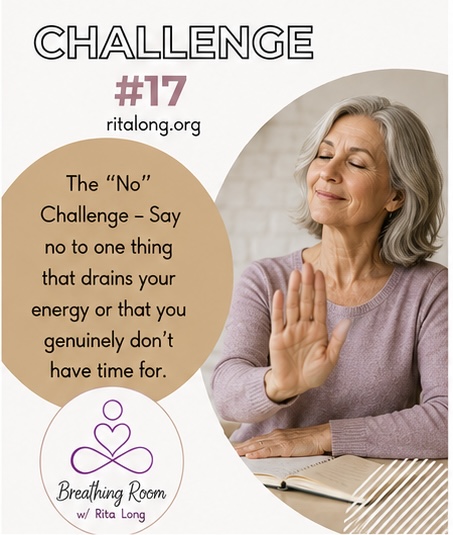
Challenge #17: The “No” Challenge
Sometimes saying “no” is an act of self-care.
How many times have you said yes when you really wanted to say no?
“Yes, I can do that.”
“Sure, I’ll take care of it.”
“I don’t mind.”
“It’s okay. I’ll figure it out.”
Sometimes we say yes because we don’t want to disappoint someone. Sometimes we don’t want to seem selfish. Sometimes we’re afraid someone will be upset with us.
And sometimes, after years of putting everyone else’s needs first, saying no can feel incredibly uncomfortable.
But here’s something I want you to remember:
You are allowed to have limits.
Your challenge today: Say no to one thing that drains you.
This doesn’t mean you need to suddenly start turning everyone down.
Start small.
Think about one thing you’ve been agreeing to that leaves you feeling exhausted, resentful, overwhelmed, or simply doesn’t fit into your life right now.
Maybe it’s:
Today, give yourself permission to pause before automatically saying yes.
Try saying:
“Let me think about that before I give you an answer.”
Those few words can be incredibly powerful.
They give you time to check in with yourself instead of responding out of habit.
“No” doesn’t make you a bad person.
This is especially important for women.
Many of us were taught to be caregivers, helpers, peacekeepers, wives, mothers, daughters, friends, employees, and the person everyone could count on.
We learned how to make other people comfortable.
But somewhere along the way, we may have forgotten to ask:
“What about me?”
Menopause and midlife can sometimes bring a new awareness of that question.
You may find yourself becoming less willing to tolerate things that once seemed normal.
You may want more peace.
More honesty.
More time for yourself.
More room to breathe.
That doesn’t mean you’re becoming selfish.
It may mean you’re finally listening to yourself.
You don’t owe everyone an explanation.
“No” is a complete sentence.
You don’t always have to provide a five-minute explanation for why you can’t do something.
You can simply say:
“I’m not able to do that.”
Or:
“That doesn’t work for me right now.”
Or:
“I have too much on my plate.”
And then stop.
You don’t have to fill the silence.
You don’t have to apologize for having boundaries.
Notice how it feels.
After you say no, pay attention to what happens inside you.
Maybe you feel guilty.
Maybe you feel relieved.
Maybe you feel nervous.
Maybe you immediately want to take it back.
That’s okay.
A boundary can feel uncomfortable before it feels empowering.
The goal isn’t to become someone who never helps anyone.
The goal is to become someone who chooses when to give instead of giving automatically.
Your Breathing Room reminder
Your time matters.
Your energy matters.
Your peace matters.
And your life is not meant to be spent constantly proving how much you can carry.
Today, practice one small, healthy no.
You may discover that every time you say no to something that drains you, you’re actually saying yes to yourself.
That’s your Challenge #17.
Small steps.
Big change.
And a little more Breathing Room for you.
With love,
Rita Long
Breathing Room w/ Rita Long
ritalong.org
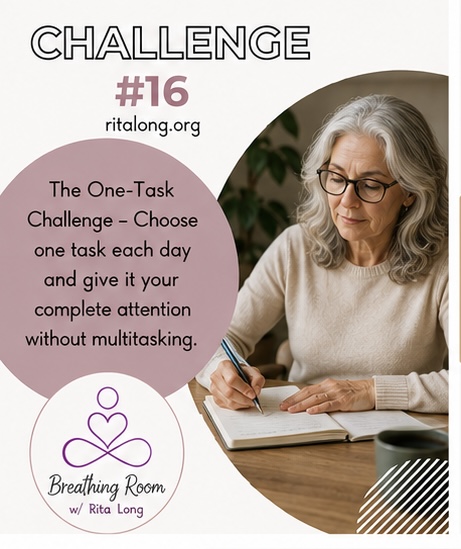
Challenge #16: The One-Task Challenge
What if doing less could actually help you accomplish more?
We live in a world that celebrates being busy.
We answer emails while eating lunch. We check our phones while watching television. We listen to a podcast while cleaning the house. We start one task, remember something else we need to do, and suddenly we’re juggling five things at once.
We call it multitasking.
But sometimes, multitasking isn’t making our lives easier. It’s making our minds tired.
Your challenge today: Do one thing at a time.
Choose one task today and give it your complete attention.
It doesn’t have to be something important or complicated. You could:
For those few minutes, allow yourself to be completely where you are.
Why this matters
Our brains need opportunities to slow down.
Constantly switching between tasks can leave us feeling scattered, even when we’ve accomplished a lot. When we focus on one thing at a time, we give our minds permission to settle.
And here’s something important:
You don’t have to earn your right to slow down.
Especially during the years of menopause and beyond, life can already feel like we’re carrying a lot. Work, family, relationships, responsibilities, changing bodies, changing priorities, and sometimes a growing realization that we don’t want to spend the rest of our lives simply rushing from one obligation to another.
Maybe this is your invitation to pause.
Not forever.
Just for one task.
Try this today
Before you begin something, take a moment and say to yourself:
“For the next few minutes, this is the only thing I need to do.”
Then notice what happens.
Notice how you feel before you begin.
Notice whether your mind tries to pull you somewhere else.
And when it does, gently bring yourself back.
No criticism.
No frustration.
Just come back.
That’s mindfulness.
A little reminder from Breathing Room
You don’t have to completely change your life to create more peace in your life.
Sometimes it starts with something as simple as putting down the phone, taking a breath, and giving yourself permission to be fully present for what you’re doing.
One thing.
One moment.
One breath at a time.
That’s your Challenge #16.
And remember—small steps can create big changes.
With love,
Rita Long
Breathing Room w/ Rita Long
ritalong.org
There was a woman I used to be
before the fire came for her,
not to destroy, though it felt that way some nights,
but to burn off everything
that was never truly mine to carry.
They don’t tell you this is initiation.
They call it change, they call it symptom,
they hand you pamphlets about hot flashes
and say nothing about the holy work of it,
how the body becomes a temple being emptied out,
swept clean of everyone else’s expectations,
room by room, cycle by cycle,
until what’s left is just you.
I lost her in there for a while.
Some nights I didn’t recognize
the woman sweating through 3am,
skin too tight, sleep too thin,
wondering where she went.
But she didn’t die. She was shedding.
The crone doesn’t arrive by accident.
She’s earned, forged in this exact fire,
this exact threshold the old traditions knew
and we forgot to honor.
Every hormone leaving
was making space
for something wiser to move in.
I’m finding her now, on the other side of the burning.
She’s steadier than the woman before her.
She bleeds wisdom instead of blood.
She doesn’t perform anymore.
She just is.
I thought this passage would take her from me.
Instead it building her.
I’m almost here now.
Ready to welcome home, my elder-self.
I’m waiting for you …
If you’ve ever stood in your kitchen at 4pm still not showered, mentally listing all the reasons you should just go do it, and still not moving — you’re not lazy, and you’re not broken. You’re probably dealing with executive dysfunction, and the question is what’s causing it: ADHD, autism, depression, or some combination of the three.
I want to walk through the differences, because the fix looks completely different depending on which one is actually driving the avoidance.
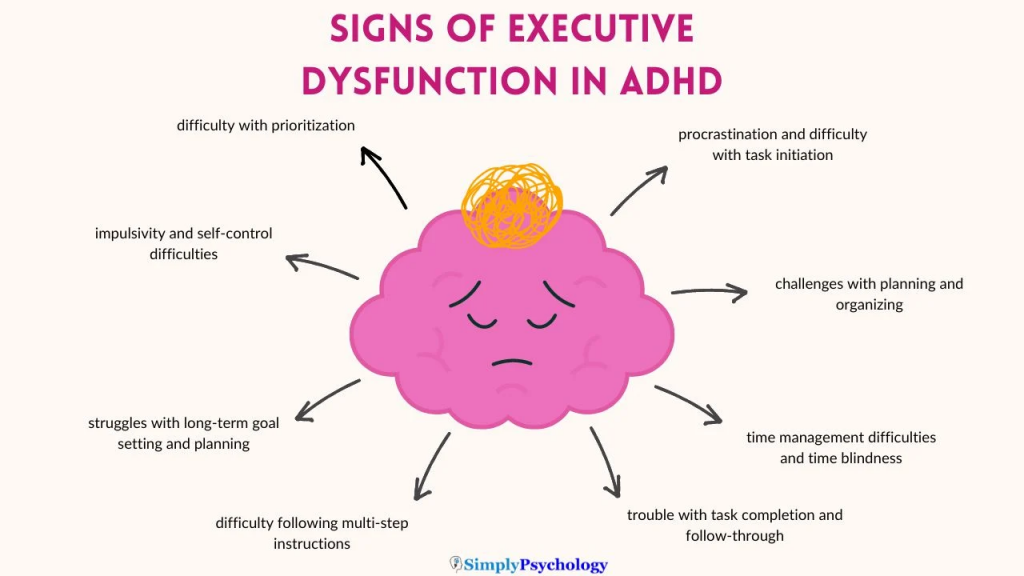
For a lot of ADHD brains, showering isn’t hard because it’s unpleasant — it’s hard because it’s a low-reward, multi-step task with no built-in urgency. There’s no dopamine hit waiting for you at the other end, so your brain treats it the same way it treats folding laundry or answering that one email: infinitely postponable.
The telltale sign here is that once you’re actually in the shower, you’re usually fine — even glad you did it. The wall is entirely at the starting line. That gap between “I should shower” and “I am showering” is where ADHD executive function struggles live.
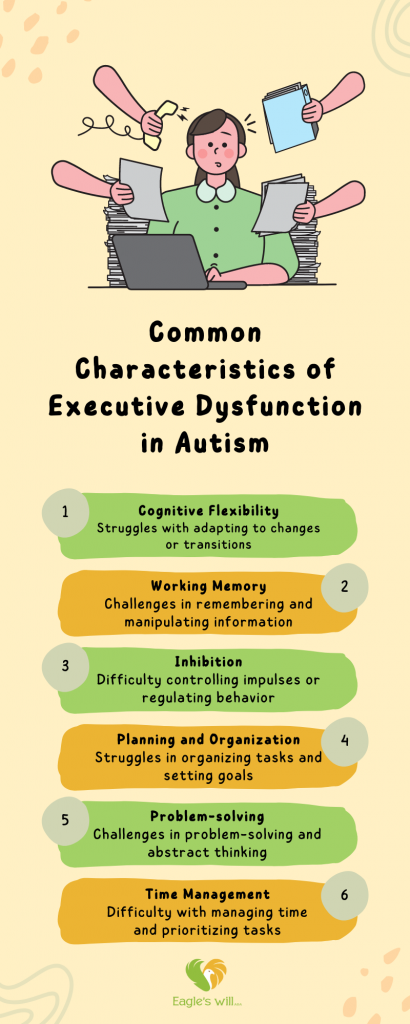
For autistic folks, the barrier is often the shower itself, not the decision to start it. Water temperature, water pressure, the texture of a towel, the smell of shampoo, the sound of water hitting the tub — any of these can range from mildly annoying to genuinely overwhelming. When your nervous system is already taxed from the day, adding a sensory-heavy task on top can trigger a kind of shutdown around self-care specifically.
The tell here: it’s not about forgetting or procrastinating, it’s an active aversion to the experience of showering, even when you know it’s time.
Depression works differently. It’s less “I can’t get started” and more “what’s even the point.” Anhedonia — the flattening of things that used to feel good or worth doing — hits basic self-care hard, because self-care requires believing you’re worth the effort. This is where the term “depression shower” comes from; it’s a well-documented symptom, not a character flaw.
The tell here: the low motivation usually isn’t isolated to showering. It shows up across eating, chores, hobbies — a general dimming, not just one stuck task.
Underneath all three of these is often the same underlying mechanism: executive dysfunction. Executive function is the brain’s management system — it’s what handles planning, initiating tasks, sequencing steps, and shifting from one activity to the next. Showering is actually a surprisingly complex executive function task: notice you need to shower, initiate the transition, sequence the steps (undress, wash, rinse, dry, redress), and manage the sensory and time demands along the way.
ADHD, autism, and depression can each disrupt this system in their own way — ADHD through under-activation of the initiation and reward circuits, autism through the added cognitive load of managing sensory input while executing steps, and depression through the sheer fatigue and low motivation that makes any multi-step task feel heavier than it should. That’s why executive dysfunction can look identical on the outside no matter which condition (or combination) is behind it: the pile of unwashed hair, the days between showers, the shame spiral about it. The visible struggle is the same; the internal cause is different.
This is also why “just do it” advice tends to fail across the board. Executive dysfunction isn’t a willpower problem — it’s a brain-based difficulty with the mechanics of starting and carrying out a task, regardless of how much you want to do it.
Here’s the part that makes this genuinely confusing: ADHD and autism frequently co-occur, and both can contribute to depression over time — especially when you’ve spent years being told to just “try harder” at things your brain and body were never going to respond to that way. So if you read all three sections and thought “yes, and yes, and also yes,” that’s not you overthinking it. That’s a very real and very common overlap.
Knowing why you’re avoiding the shower changes what actually helps:
If this is a passing rough patch, some self-compassion and small adjustments might be enough. If it’s a persistent pattern affecting your daily functioning, it’s worth bringing to a therapist or psychiatrist who understands neurodivergence — because “just push through it” was never going to work, and it was never actually about the shower.