Painting Your Feelings: How Color Shapes Emotion in Art Therapy

The colors we reach for say more than we realize — and intentional color choice can become one of the most powerful tools in emotional healing.

image
art therapy for relaxation

Have you ever felt instantly calmer stepping into a room painted soft sage green? Or noticed a surge of energy when you wore something bright red? Color is rarely neutral. It speaks to something primal in us — influencing mood, memory, and meaning long before we find the words to describe what we’re feeling.

Art therapy takes this intuition seriously. Rather than treating color as decoration, it treats color as communication — a language available to everyone, regardless of artistic skill.

image
image

What is the color wheel of emotions?

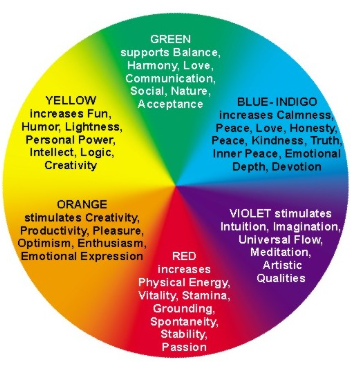
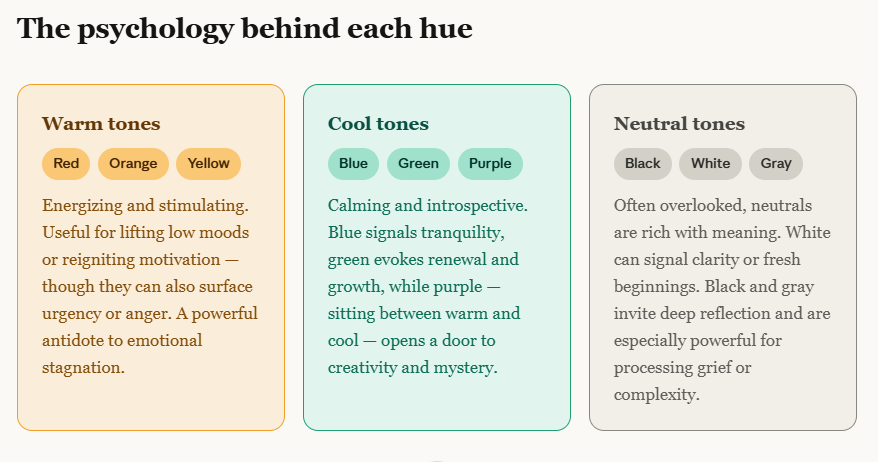
The color wheel of emotions is a framework rooted in psychology that pairs colors with specific emotional states. Think of it as an emotional vocabulary for those moments when feelings are present but words aren’t. Red might surface as passion or frustration. A deep, quiet blue might represent the particular heaviness of grief — or the open spaciousness of peace. The same color can hold opposing truths, which is part of what makes working with it so revealing.

In art therapy settings, this framework helps people externalize what’s internal — giving visible form to experiences that might otherwise stay locked inside.

image
Color tones

How art therapists work with color

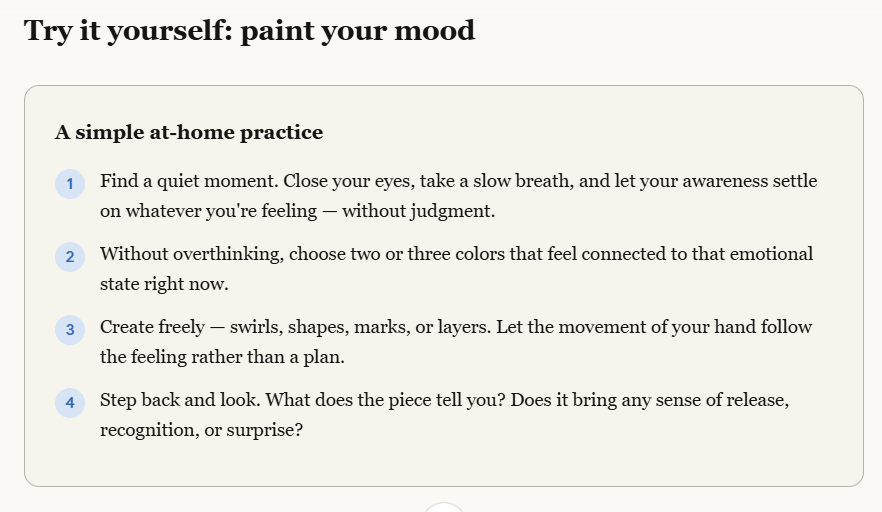
In a session, a therapist might invite a client to choose colors that feel true to what they’re experiencing right now — not what looks good, but what feels honest. Someone moving through anxiety may find themselves drawn to blues and greens without quite knowing why. Someone who feels emotionally stuck might instinctively reach for vivid yellows and oranges.

The act of choosing is itself meaningful. And what emerges on the canvas — the weight of a brushstroke, the way colors bleed into each other, the parts left blank — often reveals more than verbal reflection alone could uncover.

A useful question to sit with during this process: Why does this color feel right today? Or: What does this shade remind me of? You might be surprised what comes up.

image

There’s no right outcome here. The goal isn’t a finished painting — it’s a moment of honest contact with yourself, expressed in color rather than words.

Color as a path to healing

What art therapy reminds us is that color is never just pigment. It carries memory, emotion, and meaning that words can miss entirely. Whether you’re processing something heavy or simply exploring how you feel on an ordinary Tuesday, picking up a brush and letting color speak can be quietly transformative.

You don’t need to be an artist. You just need to be willing to look at what you reach for — and ask yourself why.

Every shade has something to say. The question is whether we’re listening.

No Comments MindfulnessSelfcareStress Management

You Used to Dream Without Apology — Here’s How to Get That Back

image
dreaming

Ask a room full of kids what they want to be when they grow up and brace yourself.

You’ll hear things like: marine biologist, famous painter, and bakery owner — all from the same child, all in the same breath, delivered with the kind of confidence that makes you wonder when exactly the rest of us lost ours.

One kid wants to build robots and play professional soccer and also be a firefighter. Somehow simultaneously. He hasn’t figured out the schedule yet. He is not worried about the schedule.

And that’s exactly the point.


Kids don’t dream in limitations.

They don’t start with is this realistic? They don’t wonder if someone who looks like them has done it before. They don’t quietly talk themselves out of something before they’ve even said it out loud. They just… go. Full speed. No filter. No apology.

There’s no committee in their head voting on whether the dream is practical enough to mention.

So what happens?


Somewhere between childhood and adulthood, most of us learn to shrink.

It doesn’t happen in one dramatic moment. It’s a slow accumulation — a raised eyebrow from someone whose opinion mattered, a “be realistic” from a well-meaning adult, a dream that didn’t pan out the way we hoped. A few of those experiences and we start to learn: wanting too much is risky.

So we adjust. We edit. We filter our dreams through a lens of what seems reasonable, what’s been done before, what other people are likely to approve of.

We start choosing safe over alive.

We aim for things that look good on paper — even when they don’t feel that good on the inside.

We learn to call that maturity. Sometimes it is. But sometimes it’s just fear wearing a responsible-sounding disguise.


The problem isn’t that we grew up. It’s that we stopped growing outward.

There’s a real difference between wisdom and self-limitation. Wisdom helps you move forward thoughtfully. Self-limitation just keeps you stuck in place, calling it caution.

Kids aren’t wiser than adults — but they haven’t yet learned to be afraid of their own imagination. They haven’t been taught that dreaming big is something to be embarrassed about. They haven’t internalized the idea that wanting more than what you have is somehow ungrateful or unrealistic.

They just know what lights them up. And they say it.

Out loud. Without shrinking.


What would change if you did the same?

Not in a reckless, throw-everything-out way. But genuinely — what would shift if you stopped editing yourself before you even got started? If you let yourself want something without immediately running it through the filter of what will people think or has anyone like me done this before or what if I fail?

Here’s the truth: those questions will always be there. They don’t go away just because you decide to dream bigger. But they don’t have to be the first voice in the room either.

The kids aren’t fearless because they don’t understand risk. They’re free because they haven’t yet decided that their dreams need to be approved before they’re worth having.


Reclaiming that freedom as an adult looks different — but it’s still possible.

It starts with noticing the places where you’ve been quietly playing small. The ideas you’ve brushed off before fully exploring them. The things you want that you’ve stopped letting yourself say out loud because they felt too big or too different or too hard to explain to other people.

It means getting honest about the difference between I’ve thought this through and it’s not for me and I’m afraid, so I’m pretending I don’t want it.

It means being willing to sound a little like a kid at dinner again — unfiltered, unedited, unconcerned with whether the dream makes perfect sense yet.


The marine biologist slash painter slash bakery owner doesn’t need her plan to be airtight to know what excites her.

Maybe you don’t either.

Stop shrinking. Start there.

No Comments MindfulnessSelfcare

Your Brain Isn’t Broken — It’s Just Starving for a Moment of Nothing

Why learning to be bored might be the most radical thing you do this year.

5 min read Originally published March 2026


Picture this: you’re deep in the middle of something — a project, an article, a train of thought that was actually going somewhere. Then, without any warning or real reason, your hand moves to your phone. Not because something urgent happened. Not because you needed information. Just… because.

Sound familiar? Here’s the thing most people don’t realize: that moment wasn’t a failure of willpower. It was your nervous system doing exactly what it was built to do — hunting for a reward.

image

The dopamine hunger you didn’t know you had

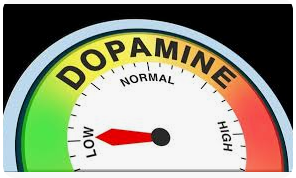
Our brains are wired to seek stimulation. When a task stops feeling interesting or rewarding, dopamine levels quietly dip. And the moment that happens, the brain starts sending out urgent requests: find me something. A notification. A headline. A thirty-second video about absolutely nothing. It doesn’t really matter what — as long as it delivers a quick signal that something is happening.

The problem isn’t that we occasionally get distracted. It’s that we’ve built entire systems — apps, platforms, feeds — specifically designed to feed that hunger on a loop. Which means we’re rarely ever actually bored anymore. And that’s a much bigger issue than it sounds.

“We’ve built an entire world designed to make sure you never have to sit with your own thoughts for more than fifteen seconds.”

Boredom is not the enemy

Here’s the counterintuitive truth: boredom is actually useful. When your mind isn’t occupied with input, it starts doing something remarkable on its own. It wanders. It connects dots. It surfaces questions and ideas and feelings that haven’t had room to breathe. Some of your best thinking — your clearest decisions, your most creative ideas — lives on the other side of boredom.

But you’ll never get there if the moment any quiet opens up, you fill it. Every time you reach for the phone to avoid a dull moment, you’re essentially telling your brain: silence is dangerous, stillness is something to escape. Over time, that message sticks.

image

Why stillness feels so uncomfortable

There’s a reason people describe silence as “deafening.” When all the noise stops, what fills the space isn’t peace — at least not at first. It’s everything you’ve been too busy to deal with. The awkward conversation you replayed a hundred times. The goal you keep putting off. The quiet truth you’ve been carefully avoiding.

We scroll past these things a dozen times a day. But when the screen goes dark and the room goes quiet, they’re still there. Waiting.

This is why stillness can feel more like a confrontation than a rest. And it’s also why it matters so much. That discomfort isn’t a sign that something is wrong — it’s a sign that your mind is finally getting a chance to process instead of just react.

Try this today

Set a timer for just ten seconds. Find a blank wall — not a window, not your phone, not the room’s most interesting corner. Stare at it. Do absolutely nothing. Notice what your brain does when you don’t hand it something to chew on. That’s where it starts.

A small experiment with a surprisingly big payoff

You don’t have to go off-grid to reclaim your attention. Start with one app — the one you reach for most automatically, the one you open without deciding to. Delete it for just 24 hours. Not to be productive. Not as some kind of punishment. Just to see what happens when that particular exit door is closed.

You’ll probably feel restless at first. Maybe even irritable. That reaction itself is worth paying attention to — it tells you how much mental real estate that app has been quietly occupying.

But something else tends to happen too. Small windows of time reappear. Thoughts start completing themselves instead of getting interrupted. You remember that your inner voice actually has things to say, once you stop talking over it with content.

This isn’t about willpower or going on a digital detox retreat. It’s about reclaiming tiny moments — the five seconds at a red light, the two minutes before a meeting, the space between one task and the next — and letting them be what they are: nothing. Just you and your brain, without an agenda.

Silence isn’t emptiness — it’s raw material

The most interesting ideas don’t usually arrive while you’re consuming something. They arrive in the gaps. In the shower. On a slow walk. In the moment after you close the laptop and haven’t opened anything else yet.

Those moments are not wasted time. They’re the conditions your mind needs to actually think — not just process input, but generate something original. When you protect even a little of that space, you’re not opting out of life. You’re opting back in to the parts of it that are actually yours.

So maybe the most rebellious thing you can do in an age of infinite content isn’t to find better content. It’s to need less of it. To tolerate a little quiet. To let boredom show you what’s underneath.

You might be surprised what’s been waiting there all along.

No Comments MindfulnessSelfcareStress Management

The Power of Words: Why What You Say Matters More Than You Think

image

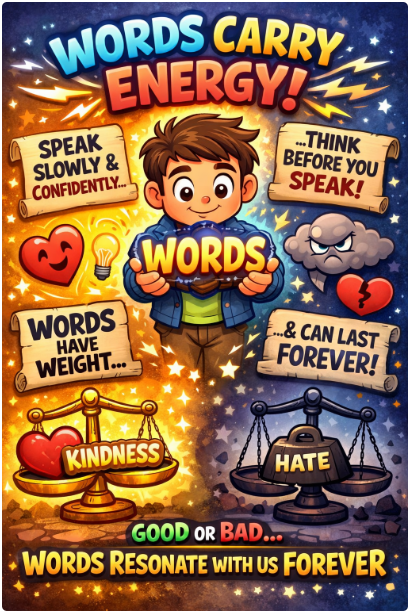
Words are not just sounds or symbols. They are energy — alive, potent, and lasting.


We live in an age of noise. Messages fly at us from every direction — social media, text threads, news feeds, casual conversations. In all of this noise, we’ve somehow convinced ourselves that words are cheap. Throwaway. Easy to take back.

They’re not.

Words carry an energy that most of us severely underestimate. They can lift a person out of the darkest moment of their life, or push someone further into it. They can build decades-long relationships, or shatter them in a single sentence. Long after the moment has passed, long after the person who said them has forgotten they ever spoke — words linger. They echo. They become the voice inside someone’s head.

That’s not a small thing. That’s extraordinary power.


Words Are Energy

Think about a time someone said something genuinely kind to you — not a polite compliment, but something that felt true. Something they didn’t have to say. Chances are, you still remember it. Maybe it came at exactly the right moment. Maybe it changed how you saw yourself.

Now think about a time someone’s words cut you. A criticism delivered carelessly. A comment made in anger. An offhand remark that the speaker probably forgot about before they’d even finished the sentence.

You remember that too, don’t you?

That is the weight of words. They don’t evaporate when the conversation ends. They settle into us. The good ones become quiet fuel — the reason we kept going, kept trying, kept believing in ourselves. The harmful ones can become invisible chains, shaping how we move through the world without us ever realizing it.

Words are not passive. They do something to the people who receive them.


Speak Slowly. Speak Confidently.

There is a quiet power in the person who doesn’t rush their words. Who pauses before they speak. Who seems unbothered by silence. In a world where everyone is in a hurry to be heard, the person who takes their time to speak well commands attention — not because they demand it, but because they’ve earned it.

Speaking slowly signals something important: I’ve thought about this. What I’m saying matters. It gives your listener time to actually receive what you’re saying, rather than simply waiting for their turn to respond. And it gives you the space to say what you actually mean, rather than what comes out in the heat of the moment.

Confidence in speech isn’t about volume. It’s not about having all the answers or never being uncertain. It’s about owning what you say. It’s the difference between “I don’t know, maybe, I could be wrong, but maybe…” and “I’m not sure yet, but here’s what I think.” Both are honest. Only one carries weight.

When you speak with confidence and intention, people listen differently. They lean in. They trust you more. And more importantly — you trust yourself more.


Think Before You Speak

This is perhaps the most radical act in modern life: actually pausing before you respond.

The impulse to react immediately is everywhere. Someone says something provocative, and every instinct fires at once — defend yourself, correct them, prove a point, match their energy. But the words that come out in those moments are rarely the words you actually want to have said. They’re reactive, not intentional. They’re born from the heat of the moment, not from your deeper self.

Thinking before you speak is not hesitation. It’s wisdom. It’s the split second where you ask yourself: Is this true? Is this necessary? Is this kind? What am I actually trying to say — and what will it actually do?

Sometimes the answer is to speak boldly, to say the hard thing that needs to be said. Other times, the most powerful choice is restraint — to let silence do the work instead. Either way, the pause is never wasted. It’s where intention lives.


Words Resonate Forever

A parent tells a child they’re not smart enough. Decades later, that grown adult still hears it in moments of self-doubt.

A teacher tells a struggling student they have something special. Years later, that student — now successful — still thinks of that moment when they needed courage.

We carry our words with us, and we carry the words of others. Some of them we chose. Some were handed to us without our permission. But what we do with the words we give to others — that is entirely in our hands.

The conversation you have today might become the voice in someone’s head tomorrow. The encouragement you offer might be the thing that keeps someone going when everything else tells them to stop. And yes, the careless, unthought remark could be the stone that someone carries for years.

This is not meant to make you afraid to speak. It’s meant to make you intentional about it.


Choose Your Words Like They Matter — Because They Do

You don’t need to be a poet or a philosopher to wield words well. You just need to be present. To slow down. To ask yourself what you actually want to say, and why.

Speak with care. Speak with courage when courage is needed. Speak with kindness when kindness is what the moment calls for. And when in doubt — pause. Think. Let the silence breathe for a moment before you fill it.

Because words, once spoken, belong to the world. They go places you never intended, touch people you’ll never know, and last longer than you’ll ever realize.

Use them well.


“The tongue has no bones, but it is strong enough to break a heart. Be careful with your words.”

No Comments Mindfulness

Gratitude Prompts

image

People & Relationships 

  1. Who made you feel seen or heard recently? 
  1. Who in your life do you take for granted that you couldn’t live without? 
  1. Who believed in you before you believed in yourself? 
  1. Who made you laugh this week? 
  1. Who showed up for you during a hard time? 
image

Simple Everyday Moments  

6. What’s something you experienced today that you’d miss if it were gone?  

7. What’s a comfort in your daily routine you rarely stop to appreciate?  

8. What’s a sound, smell, or taste that instantly makes you feel at home?  

9. What’s something your body did today that you’re grateful for?  

10. What’s a small luxury you have that once felt out of reach? 

Challenges & Growth  

11. What’s a hard season of life that made you stronger?  

12. What’s a mistake that ended up teaching you something valuable?  

13. What’s a door that closed that led you somewhere better?  

14. What’s a fear you faced that you’re proud of? 15. What’s something you once worried about that never happened? 

The Overlooked  

16. What’s something working perfectly in your life that you never think about?  

17. What’s a skill or talent you have that you don’t give yourself credit for?  

18. What’s a place you’ve been that left a mark on you?  

19. What’s something in nature that stopped you in your tracks?  

20. What’s a book, song, or movie that changed how you see the world? 

image

Abundance & Opportunity  

21. What opportunities do you have today that a younger version of you would have dreamed of?  

22. What resources do you have access to that make your life easier?  

23. What freedoms do you have that you don’t think about often?  

24. What’s something you get to do today versus have to do?  

25. What’s a goal you’ve already achieved that you’ve stopped celebrating? 

Self & Inner Life  

26. What’s something you genuinely like about yourself?  

27. What value or belief guides your life that you’re grateful you developed?  

28. What’s a habit that’s quietly improving your life?  

29. What’s a moment from your past that still brings you joy when you think about it?  

30. If today were your last day, what would you be most grateful you experienced? 

No Comments GratitudeMindfulness

Why You Can Excel at Work and Fall Apart at Home

Part Five of the DBT & Emotional Wellness Series

The Hidden Truth About How Your Nervous System Really Works

You are a completely different person at work than you are at home. At work, you are reliable, capable, and switched on. You hit your deadlines, handle difficult conversations, and keep it all together in ways that would genuinely impress people if they could see it. Then you walk through your front door — and something shifts. The laundry sits untouched. The dishes pile up. The energy that carried you through the entire workday evaporates so completely that you wonder if it was ever really yours to begin with.

If you have ever looked at this gap and decided it meant something was wrong with you — that you are somehow inconsistent, hypocritical, or secretly lazy — I want to offer you a completely different explanation.

Nothing is wrong with you. What is happening is neurological, deeply human, and far more understandable than most people realize.

Two Environments, Two Completely Different Nervous Systems

Here is the core truth that changes everything: your ability to function is not just about you — it is about the conditions surrounding you. Work and home are not two versions of the same environment. They are two entirely different operating systems, and your brain responds to them accordingly.

At work, the structure already exists before you arrive. The schedule is set. The expectations are clear. The consequences for falling behind are immediate and visible. Other people are counting on you in ways that feel concrete and real. Your brain does not have to generate a reason to move forward — the environment hands it one every hour of the day.

At home, none of that scaffolding exists. Every task requires you to generate your own motivation, build your own structure, set your own priorities, and hold yourself accountable entirely from the inside. For a brain and nervous system that are already running low, that is an almost impossible amount of invisible labor to ask.

The Performance Tax You Pay Every Day Without Realizing It

There is something that happens between your first cup of coffee and the moment you walk back through your front door that most people never account for. It is called the performance tax — and it is very, very real.

Throughout the workday, most of us are not just doing our jobs. We are also carefully managing how we appear while we do them. We hold our frustration when a meeting runs long. We smile through conversations that drain us. We push through the afternoon slump without letting anyone see how hard we are working just to stay present. We adjust, adapt, regulate, and perform — and we do all of it simultaneously, often without any awareness that it is happening.

That ongoing effort to manage both your actual work and your external presentation is neurologically expensive. It draws on the same finite mental and emotional resources that you will need later to handle everything waiting for you at home.

By the time you arrive home, you are not starting your personal life with a full tank. You are starting it with whatever is left over after the workday already took its cut. And often, that is not very much at all.

Why Home Is Where the Mask Finally Comes Off

Here is the paradox that sits at the center of all of this, and it is one worth sitting with for a moment.

The reason you fall apart at home is not because home is where you fail. It is because home is where you finally feel safe enough to stop performing.

Your nervous system is constantly scanning the environment around you, assessing whether it is safe to let your guard down. At work, the social stakes are high enough that your brain keeps that guard firmly in place. There are professional norms, power dynamics, and reputational considerations that keep your system regulated even when everything inside you wants to unravel.

But the moment you step into your home — your own space, with no audience, no performance required — your nervous system reads the room and finally exhales. Everything you were holding together all day begins to surface. The fatigue, the stress, the emotional residue of a hundred small moments you did not have time to process. It all comes up at once.

That release is not weakness. That is your nervous system doing exactly what healthy nervous systems do — they regulate up when the environment demands it and they release when it is finally safe to do so. The problem is not that you are releasing. The problem is that the release has become so total, so immediate, that it tips from relief into shutdown.

The Science Behind the Shutdown

Your brain has a component called the prefrontal cortex — the part responsible for planning, organizing, making decisions, and initiating tasks. It is essentially your internal project manager. When it is well-rested and operating in a low-stress environment, it runs your to-do list with relative efficiency.

When stress hormones are elevated — which they often are after a full day of demands, deadlines, and social navigation — that part of your brain begins to slow down. Its ability to prioritize, sequence, and initiate tasks diminishes significantly. This is why you can look directly at something that needs to be done and still not be able to figure out where to begin. It is not a motivation problem. It is a neurological one.

Add to that the reality that home tasks, unlike work tasks, are rarely broken down into clear, sequential steps with defined starting points. A pile of laundry is not a task. It is an undefined cluster of decisions — sort, wash, dry, fold, put away — each of which requires its own initiation. Your depleted brain looks at that cluster and cannot find the entry point. So it does not enter at all.

This is functional freeze in action — and it is not a character flaw. It is your brain protecting itself from a demand it does not currently have the resources to meet.

The Role of External Accountability

One of the most underappreciated differences between work and home is the presence — or absence — of external accountability. At work, other people are watching. Deadlines have real consequences. Your performance is visible, measured, and tied to outcomes that matter beyond just your own comfort.

Human beings are wired for social accountability. We are a deeply communal species, and our nervous systems are designed to respond to the presence of others in ways that activate our focus and follow-through. When someone else is counting on us, we find resources within ourselves that seem to appear out of nowhere.

At home, that external pressure is largely absent. The dishes do not care if you do them tonight or next week. The laundry will not send a follow-up email. And so the part of your brain that responds to social accountability sits quiet — while the pile grows and the guilt builds on top of it.

What You Can Actually Do About It

Understanding why this happens is the first and most important step. But understanding alone does not fold the laundry. Here are some ways to bridge the gap between work-you and home-you in a way that works with your nervous system rather than against it.

Create a transition ritual

Your nervous system needs a clear signal that you are shifting gears — not from fully on to completely off, but from work mode to home mode. Without that signal, the drop from peak performance to total shutdown can be immediate and extreme. A transition ritual gives your brain a middle ground to land on.

This could look like changing out of your work clothes the moment you arrive home, taking a ten-minute walk before you come inside, sitting in your car for five minutes of quiet before you go in, or putting on a specific playlist that signals the shift. The content of the ritual matters less than the consistency. Do the same thing every day and your nervous system will begin to use it as a regulation tool.

Bring structure home on purpose

Your brain thrives inside structure that exists outside of your head. At work, that structure is built into the environment. At home, you have to build it yourself — but the good news is that even a loose, flexible framework is significantly better than none at all.

Try creating a simple evening rhythm rather than a rigid schedule. Not a military timeline — just a general flow. Wind down first, then one small task, then dinner, then whatever you need. The predictability of a loose routine gives your executive function something to follow without overwhelming a system that is already depleted.

Borrow the accountability your brain is missing

Since your nervous system responds to external accountability in ways it simply cannot replicate internally when depleted, give it some. Text a friend and tell them you are going to do one task and report back when you are done. Set a visible timer and treat it like a meeting you cannot miss. Put on a show you only allow yourself to watch while you are doing something productive. Work alongside someone else, even virtually.

You are not cheating by needing these tools. You are simply giving your brain the conditions it needs to perform — the same way your workplace does, just in a different form.

Redefine what rest actually means

One of the reasons people cycle between pushing too hard and crashing completely is that they never build in rest that is real, intentional, and guilt-free. Rest that comes with a side of shame is not rest — it is just a pause in the self-criticism.

Decide in advance that a specific amount of time is for genuine recovery — not productivity in disguise, not passive scrolling, but actual restoration. Then protect that time fiercely. A nervous system that gets real rest returns to function far more efficiently than one that is shamed into pushing through on empty.

The Reframe That Changes Everything

You are not two different people. You are one person operating under two radically different sets of conditions — and performing accordingly.

The version of you that shows up reliably at work is not your real self and the version that struggles at home is not your real self either. They are both real. They are both you. And the difference between them has far more to do with environment, structure, and nervous system resources than it does with character, discipline, or worth.

Stop measuring your worth by which version of yourself you see most often. Start measuring it by the fact that you keep showing up — at work, at home, and in these quiet moments of honest self-reflection — even when it is hard. Even when the gap feels impossibly wide.

The gap is not evidence of your failure. It is a map pointing directly toward what you need. And now that you can read it, you can finally start to close it.

You are not behind. You are not broken. You are just learning — and that is exactly where you need to be.

No Comments MindfulnessSelfcareStress Management

Functional Freeze — Why You Can See Everything That Needs to Be Done and Still Not Be Able to Move

Part Four of the DBT & Emotional Wellness Series


Have you ever stood in the middle of a messy room, looked around at everything that needed to be done, and then simply walked away? Not because you did not care. Not because you were being lazy. But because something inside you just — stopped?

Have you ever laid down in the middle of the day, not because you were physically exhausted, but because continuing forward felt genuinely impossible?

If that sounds familiar, I want you to know something important before we go any further.

You are not lazy. You are not broken. You are not failing at life.

What you are experiencing has a name — and understanding it might be one of the most compassionate and clarifying things you do for yourself today.


What Is Functional Freeze?

Functional freeze is what happens when your nervous system becomes so overwhelmed that it shifts into a kind of internal shutdown mode. It is not a mental illness. It is not a personality flaw. It is a survival response — one that your brain and body have been running since long before you were born.

Here is the simplest way to understand it.

Your nervous system has three basic responses to perceived threat or overwhelm. You have probably heard of fight and flight — the responses that push you toward action, either to confront something or escape it. But there is a third response that does not get nearly enough attention, and that is freeze.

Freeze is what happens when fighting feels impossible and running feels pointless. Your system does not know what else to do, so it does the only other thing it can — it goes very, very still.

The word “functional” is important here because this is not the kind of freeze that leaves you completely unable to move or speak. You can still go through the motions of your day. You can still hold a conversation, scroll your phone, and make a cup of coffee. But the deeper, more meaningful tasks — the ones that require decision making, emotional energy, or sustained focus — become almost impossible to access.

You are present. But you are not fully online.


Why You Can See the Mess and Still Walk Away

This is the part that people judge themselves most harshly for, and I want to address it directly.

You are not walking away because you do not care. You are not walking away because you are unmotivated or irresponsible. You are walking away because your brain genuinely cannot find a safe entry point into the task.

Here is what is actually happening beneath the surface.

When you look at a cluttered room your brain does not process it as one single task. It processes it as hundreds of tiny decisions all demanding your attention at the same time. Where do I start? What goes where? What if I start and cannot finish? What does finishing even look like? Is there even a point?

That avalanche of micro-decisions floods your executive function — the part of your brain responsible for planning, prioritizing, and initiating action. And when your nervous system is already running in a stressed or overwhelmed state, executive function is one of the very first things to go offline.

So you look at the room. Your brain tries to find a starting point. It cannot locate one quickly enough. Your system interprets that as a threat. And your body responds the only way it knows how in that moment.

You walk away.

Not because you chose to give up. But because your nervous system made that choice before your conscious mind even had a chance to weigh in.


Why You Lay Down

When you find yourself lying down in the middle of the day — not from physical tiredness but from a kind of bone-deep inability to keep going — that is your nervous system doing something very specific.

It is shifting into what researchers call the dorsal vagal state. In plain language, your body is conserving every resource it has because it has decided, below the level of your conscious awareness, that the situation is too much to handle right now.

It is the same ancient instinct that causes animals to go completely still when they sense a predator nearby. Stillness as protection. Stillness as survival.

Except in your case the predator is not a physical threat. It is an overwhelming to-do list. An emotion you cannot name or process. A decision that feels too heavy. The accumulation of everything you have been carrying without enough support or rest.

Your body does not know the difference between a lion and an impossible afternoon. It just knows that something feels like too much — and it responds accordingly.

This is not weakness. This is your nervous system working exactly as it was designed to. The only problem is that it was designed for a very different world than the one we are living in now.


What Is Actually Happening Underneath the Surface

Functional freeze rarely appears out of nowhere. It is usually the end result of one or more of these underlying experiences:

Chronic stress or burnout. When your nervous system has been running on high alert for an extended period of time it eventually stops responding with anxiety and hyperactivity and starts responding with numbness and shutdown instead. This is not you giving up. This is neurological exhaustion. Your system has been working overtime for so long that it has simply run out of fuel.

Unprocessed trauma. You do not have to have experienced something dramatic or catastrophic for trauma to be part of your story. Smaller, quieter experiences — years of feeling unseen, relationships that required you to shrink yourself, environments that never felt fully safe — can all train your nervous system to default to freeze when things feel uncertain or unmanageable.

Executive function overload. Executive function is essentially your brain’s project manager. It handles planning, prioritizing, initiating, and following through. When stress hormones flood your system that project manager goes on emergency leave. Tasks that should feel simple suddenly feel impossible — not because you are incapable but because the part of your brain responsible for managing them has temporarily gone offline.

Emotional overload. Sometimes the freeze has absolutely nothing to do with the physical task in front of you. Sometimes you are carrying something so heavy emotionally that your entire system is consumed by the effort of holding it together. There is simply no bandwidth left for action because every available resource is already being used just to keep you upright.


The Shame That Makes It Worse

Here is something that is critical to understand.

Shame does not break the freeze. It deepens it.

Every time you look at what you could not do and tell yourself you are lazy, worthless, or pathetic — every time you compare yourself to people who seem to move through their days effortlessly — you are adding more weight to a system that is already buckling under pressure.

Shame is not a motivator for people in freeze. It is a reinforcer of it. Because shame is itself a threat, and more threat is the last thing an already overwhelmed nervous system needs.

This does not mean you get a free pass to never do anything. It means that the path forward runs through compassion, not criticism. And that might feel uncomfortable if you have spent years believing that being hard on yourself was the only way to keep moving.

It was not. It never was.


How to Gently Come Back Online

The goal when you are in functional freeze is not to force yourself into action through willpower. The goal is to signal to your nervous system that it is safe enough to come back online. These two approaches look very different from each other and they produce very different results.

Here are some gentle, practical ways to create that opening:

Start with your body, not your brain. Freeze lives in stillness. The fastest way to begin shifting out of it is through movement — even tiny movement. Shake your hands out. Roll your shoulders. Walk to a different room. Put on one song and let your body move however it wants to. You are not trying to motivate yourself. You are trying to regulate your nervous system enough to create a small crack of possibility.

Make the smallest decision possible. Not “clean the whole house.” Just “pick up one thing.” One cup. One sock. One piece of mail. The size of the action does not matter. What matters is that you moved. Any movement signals to your brain that forward is possible, and that signal can slowly begin to thaw the freeze.

Name what is happening without judgment. Simply saying to yourself “I am in freeze right now and that makes sense” activates the thinking part of your brain and begins to quiet the alarm. You are not excusing inaction. You are creating the self-awareness that makes action possible again.

Lower the bar dramatically and mean it. Instead of “I need to be productive today” try “I am going to be upright for ten minutes.” Instead of “I need to clean the kitchen” try “I am going to put one dish in the sink.” You are not setting low standards forever. You are meeting your nervous system where it actually is right now, because that is the only place you can ever start from.

Reduce sensory overwhelm. Sometimes freeze is made worse by too much noise, too much visual clutter, too much input coming at you from too many directions. If you can, simplify your environment temporarily. Turn off background noise. Sit somewhere quieter. Give your senses a chance to settle before you ask your brain to perform.

Be honest with someone you trust. Isolation deepens freeze. You do not have to explain everything or have it all figured out. Sometimes just saying “I am really struggling to get started today” to another human being is enough to shift something. Connection is one of the most powerful nervous system regulators we have access to.


What Functional Freeze Is Trying to Tell You

Here is the reframe that I want you to sit with.

Functional freeze is not the enemy. It is a messenger.

It shows up when something in your life needs attention — not necessarily the dishes, not necessarily the mess, but something deeper. Something in you that has been pushed aside, ignored, or run past for too long.

When you find yourself frozen, instead of immediately trying to break out of it or shame yourself for being in it, try asking a gentler question. What is actually going on with me right now? What have I been carrying that I have not had space to put down? What does my nervous system need that it has not been getting?

The answers to those questions will tell you far more than any productivity tip ever could.


You Are Not Behind. You Are Overwhelmed.

There is a version of you that moves through your days with clarity and ease. That version is not gone. It has not abandoned you. It is just waiting for your nervous system to feel safe enough to come back online.

And that safety does not come from pushing harder. It comes from understanding what is actually happening, treating yourself with the kind of patience you would offer someone you love, and taking one small step — not because you have it all figured out, but because one small step is enough to begin.

You already took one today by being here and reading this.

That counts more than you know.

No Comments MindfulnessSelfcareStress Management

DBT — How to Actually Start Practicing These Skills in Your Everyday Life

Emotional Wellness Series  |  Part three

You have learned what DBT is. You have gone deeper into each of the four core skills. Now comes the part that most people skip — actually putting it into practice.

Reading about DBT is one thing. Living it is another. The gap between knowing something and doing something is where most people get stuck, and that is completely understandable. Change is uncomfortable, new habits feel awkward at first, and life rarely slows down long enough to give you the perfect moment to start.

So let’s talk about how to begin — not perfectly, not all at once, but in real, manageable ways that fit inside the life you are already living.


Start With One Skill, Not Four

One of the most common mistakes people make when they discover DBT is trying to implement everything at the same time. They want to be mindful, regulate their emotions, tolerate distress, and communicate effectively all at once — and within a week they feel overwhelmed and give up.

Do not do that to yourself.

Pick the one skill that speaks most directly to where you are right now. If your biggest struggle is feeling hijacked by your emotions in the moment, start with mindfulness. If your relationships feel like a constant source of pain or confusion, start with interpersonal effectiveness. If you are going through something particularly hard right now and you are just trying to get through it without falling apart, distress tolerance is your starting point.

Give yourself permission to go slow. Depth is more valuable than speed here.


Practicing Mindfulness Every Day

You do not need a meditation cushion, a special app, or thirty minutes of silence to practice mindfulness. What you need is a willingness to pause and pay attention.

Try this today:

Start with what is called a one-minute check-in. Set a timer for sixty seconds, close your eyes if it feels comfortable, and simply ask yourself three questions — What am I thinking right now? What am I feeling in my body? What emotion is present?

Do not judge any of the answers. Just notice them.

Do this once in the morning, once in the afternoon, and once before bed. Over time you will start to notice patterns — times of day when anxiety peaks, situations that consistently trigger certain feelings, physical sensations that show up before you are even consciously aware of an emotion.

Other simple ways to build mindfulness into your day:

  • Eat one meal without your phone or television and simply pay attention to the experience of eating
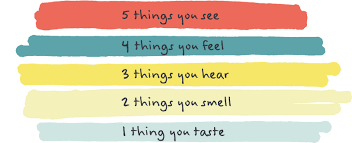
  • When you are driving or walking, notice five things you can see, four you can hear, three you can feel physically
  • Before responding to a text or email that triggered a reaction in you, take three slow breaths and notice what emotion is present before you type a single word
  • When you catch yourself spiraling into anxious thoughts about the future or painful thoughts about the past, gently bring yourself back by asking — what is actually happening right now in this moment?

The practice is not about getting it perfect. It is about returning. Every time you notice you have drifted and bring yourself back, that is the practice working.


Practicing Distress Tolerance When Life Gets Hard

Distress tolerance skills are most needed in crisis moments, which means you have to build them before the crisis arrives. You cannot learn to swim in the middle of a flood.

Build your personal crisis toolkit now, while you are calm.

Grab a piece of paper or open a notes app and answer these questions honestly:

  • What are three things that genuinely soothe me when I am overwhelmed? Think sensory — a specific playlist, a hot shower, a weighted blanket, a walk outside, the smell of something comforting
  • Who are one or two people I can contact when I am struggling who will not make it worse?
  • What is one physical activity that helps me release tension — even if it is just stretching or walking around the block?
  • What is a phrase or reminder I can come back to when everything feels like too much?

Write these down somewhere accessible. When you are in the middle of a distress spiral your brain will not generate these answers easily. Having them ready in advance is not a sign of weakness — it is a sign of self-awareness.

Practice radical acceptance with small things first.

You do not have to start with the heaviest pain in your life. Begin practicing acceptance with smaller frustrations — traffic that makes you late, plans that fall through, a conversation that did not go the way you hoped. When something does not go your way, try saying out loud or in your head — “This is what is happening right now. I do not have to like it. I just have to acknowledge that it is real.”

Notice how that small shift changes your relationship with the frustration. Over time, you will build the muscle to apply it to bigger things.


Practicing Emotion Regulation Throughout Your Week

Emotion regulation becomes a daily practice when you start treating your emotions like information rather than inconveniences.

Start an emotion journal — and keep it simple.

You do not need to write pages. At the end of each day, jot down:

  • One emotion I felt strongly today
  • What triggered it
  • What it felt like in my body
  • What I did in response
  • Whether that response served me or not

That is it. Over weeks, this simple practice will reveal patterns you have never noticed before. You will start to see which situations consistently activate certain emotions, which physical sensations are early warning signals, and which of your habitual responses are helping you versus holding you back.

Practice naming your emotions with more precision.

Most of us cycle through a very limited emotional vocabulary — happy, sad, angry, anxious. But emotions are far more nuanced than that, and the more precisely you can name what you are feeling the less power it has over you.

When you notice a strong emotion, push yourself to get specific. Instead of “I feel bad” ask yourself — is this shame, disappointment, loneliness, fear, grief, embarrassment, or something else entirely? There are resources online called emotion wheels that list dozens of emotions organized by category. Keep one on your phone and refer to it when you are trying to identify what is actually happening inside you.

Take care of the basics without negotiating on them.

DBT is very direct about this — your emotional system is directly tied to your physical state. When you are sleep deprived, undernourished, isolated, or physically unwell, your emotional regulation capacity drops significantly. This is not a character flaw. It is biology.

Identify the one physical area that most consistently undermines your emotional stability. Is it sleep? Is it skipping meals? Is it spending too much time alone? Is it scrolling your phone until midnight? Pick one and make one small, concrete change this week. Just one. Let that be enough for now.


Practicing Interpersonal Effectiveness in Real Relationships

This is the skill that will feel most uncomfortable at first because it asks you to change how you show up with other people — and people will notice. Some will welcome it. Some will push back. Stay the course anyway.

Before your next important conversation, do a quick three-question check-in:

One — What do I actually want from this interaction? Be honest with yourself. Are you looking to be heard, to solve a problem, to set a limit, or to repair something?

Two — How do I want this person to feel about me and our relationship when the conversation is over?

Three — How do I want to feel about myself when it is done?

Answering these questions before the conversation begins will completely change how you show up in it. You will be clearer, calmer, and far less likely to say something you regret.

Practice making direct requests.

Most people hint at what they need rather than asking for it clearly, and then feel hurt when the other person does not pick up on it. This week, practice replacing hints with honest, direct requests.

Instead of “I’ve just been so exhausted lately” try “I could really use some help with dinner tonight.”

Instead of “I feel like we never spend quality time together” try “I would love for us to plan something just the two of us this weekend.”

Direct communication feels vulnerable at first. But it is also one of the most respectful things you can offer another person — clarity. It removes guesswork and gives the relationship a real chance.

Practice saying no — and sitting with the discomfort that follows.

Setting a boundary is one thing. Tolerating the anxiety that comes after it is another. Many people set a limit and then immediately backpedal the moment the other person seems disappointed or upset.

Start small. Say no to one low-stakes request this week without over-explaining, apologizing excessively, or taking it back. Notice the discomfort that follows. Notice that you survived it. Notice that the relationship, more often than not, survived it too.

Each time you do this, the discomfort shrinks a little. And your self-respect grows a little. That is the trade, and it is absolutely worth it.


The Most Important Thing to Remember

Progress in DBT does not look like perfection. It does not look like never getting overwhelmed, never losing your temper, never feeling like too much for yourself or for others. Progress looks like recovering faster. Catching yourself sooner. Choosing differently more often than you used to.

There will be days when every skill you have practiced goes straight out the window and you react in exactly the way you were trying not to. That is not failure. That is being human. What matters is what you do next — whether you shame yourself into paralysis or whether you take a breath, acknowledge what happened, and decide to try again.

DBT is not a destination. It is a practice. And like any practice, it rewards the people who keep showing up — not the people who show up perfectly.

You have already started by being here and reading this. That counts for more than you know.


This is Part Three of a three-part series on Dialectical Behavior Therapy. If you missed Part One or Part Two, go back and start from the beginning — each post builds on the last.

No Comments MindfulnessSelfcareStress Management

DBT – A Deeper Look at the Four Skills That Can Change How You Move Through the World

Emotional Wellness Series  |  Part two

If you read Part One, you already know that Dialectical Behavior Therapy is not just a clinical concept — it is a practical, proven skill system for people who want to understand themselves more deeply and live more intentionally. Now it is time to go further. Each of the four core DBT skills deserves its own spotlight, because when you truly understand what each one is asking of you, the real transformation begins.


Skill One — Mindfulness: Learning to Witness Yourself Without Judgment

Most of us believe we are aware of what is happening inside us. But awareness and mindfulness are not the same thing. Real mindfulness is the practice of observing your thoughts, emotions, and physical sensations in real time — without immediately labeling them as good or bad, right or wrong.

Think of it like sitting beside a river and watching the water move. You are not jumping in. You are not trying to stop the current. You are simply watching, noticing, and staying present.

In DBT, mindfulness is considered the foundation skill because every other skill depends on it. You cannot regulate an emotion you have not noticed. You cannot tolerate distress you are too reactive to observe. You cannot communicate effectively in a relationship if you do not know what you actually need in the first place.

Mindfulness in practice looks like:

  • Pausing before responding in a heated conversation
  • Noticing when your body is tense before your mind has caught up
  • Recognizing a familiar thought pattern without automatically following it
  • Sitting with discomfort long enough to understand it rather than escape it

The goal is not emptying your mind or achieving some peaceful state of calm. The goal is building the muscle of self-observation so that your emotions become data you can work with rather than waves that knock you over.


Skill Two — Distress Tolerance: Getting Through the Fire Without Burning Everything Down

Here is the truth about distress tolerance that most people miss — it is not about fixing the problem. It is about surviving the moment without making things worse.

There will be times in life when nothing can be solved right now. The relationship is broken, the situation is painful, the news is devastating, and there is absolutely nothing you can do about it in this moment. Distress tolerance gives you a toolkit for exactly that space — the gap between the crisis and the resolution.

Without this skill, people in intense emotional pain tend to reach for whatever brings immediate relief, even when that relief comes at a serious cost. They might lash out at someone they love, make an impulsive decision, or engage in a behavior that feels good for five minutes and creates consequences that last far longer.

Distress tolerance teaches you to ride the wave instead of fighting it or drowning in it.

Some of the core strategies include:

  • Radical acceptance — acknowledging reality exactly as it is, not as you wish it were. This does not mean you are okay with what happened. It means you stop fighting the fact that it did, because that fight is the source of so much extra suffering.
  • Grounding techniques — bringing yourself back to the present moment through your five senses when anxiety or panic pulls you into your head
  • Self-soothing — intentionally engaging in something that calms your nervous system, whether that is a walk, music, warmth, or simply slowing your breathing
  • Distraction with purpose — temporarily shifting your focus not to avoid the problem, but to give yourself enough breathing room to approach it more clearly

The shift distress tolerance asks you to make is subtle but powerful. Instead of asking “how do I make this stop?” you start asking “how do I get through this without losing myself?”


Skill Three — Emotion Regulation: Understanding What You Feel and Why It Showed Up

If mindfulness is learning to notice your emotions, emotion regulation is learning to actually work with them. This is where things get deeply personal — and deeply transformative.

People who struggle with emotion regulation often describe their emotional world as unpredictable. They feel blindsided by how quickly their mood can shift, confused about why certain things trigger such intense reactions, and frustrated by how hard it is to calm down once they are activated. If that resonates, emotion regulation skills were built for exactly this.

The foundation of this skill is understanding that emotions are not random. Every emotion has a trigger, a physical sensation, a thought that accompanies it, and a behavior it pushes you toward. When you can map that process, you stop being a passenger in your emotional experience and start becoming the driver.

Emotion regulation in practice involves:

  • Identifying and naming emotions with precision — not just “I feel bad” but “I feel ashamed” or “I feel rejected” or “I feel afraid of being abandoned.” Naming an emotion with accuracy reduces its intensity almost immediately.
  • Understanding the function of your emotions — every emotion exists for a reason. Fear protects you. Grief honors what mattered. Anger signals that a boundary has been crossed. When you understand why an emotion showed up, you can respond to what it is actually telling you.
  • Reducing emotional vulnerability — this is about taking care of the basics. Sleep deprivation, poor nutrition, isolation, and unaddressed physical health all make your emotional system significantly harder to manage. DBT takes this seriously, because the state of your body directly affects the state of your emotions.
  • Opposite action — one of the most powerful tools in DBT. When you identify that an emotion is pushing you toward a behavior that will not serve you, you intentionally do the opposite. Shame tells you to hide — opposite action says reach out. Fear tells you to avoid — opposite action says take one small step toward it. This is not about suppressing the emotion. It is about not letting it steer unchecked.

Emotion regulation is ultimately about building a relationship with your inner world — one that is honest, compassionate, and grounded in understanding rather than fear.


Skill Four — Interpersonal Effectiveness: Showing Up Fully Without Disappearing Into Others

Relationships are where most of our growth happens — and where most of our pain originates. Interpersonal effectiveness is the DBT skill that helps you navigate that reality with clarity, confidence, and integrity.

At its core, this skill is about learning to balance three things that often feel like they are in conflict with each other: getting what you need, maintaining the relationship, and keeping your self-respect intact. Most people unconsciously sacrifice one of these in every interaction without even realizing it.

Some people are so focused on keeping the peace that they never ask for what they actually need. Others protect themselves so fiercely that they push people away without meaning to. And many people give so much of themselves to their relationships that they lose track of who they are outside of them.

Interpersonal effectiveness teaches you that you do not have to choose.

The key components of this skill include:

  • Knowing what you want from an interaction before it starts — Are you looking to be heard? Do you need to make a request? Are you trying to set a limit? Clarity before the conversation makes everything that follows more effective.
  • Communicating directly and respectfully — This means saying what you mean without aggression, manipulation, or over-apologizing. It means using language that is firm but kind, honest but considerate.
  • Setting and holding boundaries — Boundaries are not walls. They are honest communications about what you need in order to stay in a relationship in a healthy way. DBT teaches you not only how to set them but how to maintain them when they are tested — because they will be tested.
  • Validating others while still honoring yourself — One of the most underrated relationship skills is the ability to genuinely understand someone else’s perspective while still standing in your own truth. You can say “I understand why you feel that way and I also need this.” Both things can be true at the same time.
  • Protecting your self-respect — Every interaction either adds to or subtracts from how you feel about yourself. Interpersonal effectiveness asks you to be intentional about that. To speak up when something matters. To walk away when something does not serve you. To show up in your relationships as someone you are proud of being.

Bringing It All Together

These four skills are not meant to be practiced in isolation. They work together as a complete system. Mindfulness helps you notice. Distress tolerance helps you survive. Emotion regulation helps you understand. And interpersonal effectiveness helps you connect — with others and with yourself.

The beauty of DBT is that it meets you exactly where you are. You do not have to have everything figured out. You just have to be willing to keep showing up and practicing, one skill at a time.

Because the goal was never to feel less. It was always to feel — and to finally know what to do with it.

No Comments MindfulnessSelfcareStress Management

You Feel Everything Deeply — Here’s How to Make That Your Superpower ( Part 1)

Emotional Wellness Series  |  Part one

Some people move through life feeling things at full volume. Every emotion hits hard, every relationship carries weight, and every difficult moment can feel like it might swallow you whole. If that sounds familiar, you are not broken. You are just someone who needs the right tools to match the depth of what you carry.

That is where DBT comes in.

So What Exactly Is DBT?

Dialectical Behavior Therapy is not a wellness buzzword or a self-help trend. It is a clinically developed, research-backed skill system originally created for people who experience emotions more intensely than most. Over time it has become one of the most effective frameworks available for anyone who wants to understand themselves better, handle life’s hardest moments more gracefully, and show up more fully in their relationships.

It is built around four core skill areas — and together, they can quietly change everything.

Mindfulness — Getting Honest With Yourself

Most of us think we know what we are feeling. Mindfulness teaches us that we are often just reacting. This skill slows things down long enough for you to observe your thoughts and emotions without immediately being controlled by them. The goal is not to feel less — it is to let your emotions inform your decisions rather than make them for you. That is a meaningful difference.

Distress Tolerance — Surviving the Storm Without Making It Worse

Life will hand you moments that feel unbearable. Distress tolerance is the skill that helps you get through those moments without doing something you will regret on the other side. It is not about pretending everything is fine. It is about finding a way to hold on, stay grounded, and come out of the hard moment without losing the progress you have worked so hard to build.

Emotion Regulation — Finally Knowing What to Do With What You Feel

Have you ever felt overwhelmed by an emotion but had no idea where it came from or what to do with it? Emotion regulation skills give you a map for that. You learn to identify what you are actually feeling, understand why it showed up, and respond to it in a way that serves you rather than sabotages you. This is where real emotional intelligence starts to take shape.

Interpersonal Effectiveness — Showing Up in Relationships Without Losing Yourself

This might be the skill that surprises people the most. Interpersonal effectiveness is about learning to communicate clearly, ask for what you need, set boundaries that actually hold, and maintain your self-respect — all at the same time. It is about being present in your relationships without disappearing into them.

The Bigger Picture

DBT does not promise to make life easier. What it does is give you a structured, proven set of tools to handle life more skillfully. For people who feel deeply, that is not a small thing. That is everything.

If you have ever felt like your emotions were running the show, these four skills might just be the foundation you have been looking for.

http://blog.ritalong.org

No Comments MindfulnessSelfcareStress Management