Exploring Shadow Work: A Transformative Ritual for Self-Awareness
There are parts of ourselves that we readily share with the world—and then there are the parts we keep tucked away.
Maybe it’s anger we were taught wasn’t acceptable. Perhaps it’s jealousy, fear, insecurity, resentment, or even dreams and desires we’ve convinced ourselves we shouldn’t have. Sometimes these hidden pieces are so deeply buried that we barely recognize them as part of ourselves.
This is where shadow work comes in.
The idea of the “shadow” is commonly associated with psychologist Carl Jung, who used the term to describe aspects of ourselves that exist outside our everyday conscious awareness. Shadow work is the practice of becoming curious about these hidden or rejected parts of ourselves rather than simply pushing them away.
The purpose isn’t to judge yourself or dig up painful memories just for the sake of revisiting them. It’s about developing greater awareness of what influences your reactions, choices, relationships, and emotional patterns.
Sometimes the things we discover in our shadows aren’t “bad” at all. They may simply be pieces of ourselves we learned to hide.
Why Explore Your Shadow?
Have you ever had a reaction that seemed much stronger than the situation called for?
Maybe someone’s behavior irritated you far more than you expected. Perhaps the same type of relationship problem keeps appearing in your life. Or maybe you find yourself repeating a behavior even though you consciously want to change it.
Instead of immediately criticizing yourself, shadow work invites you to become curious.
Why did that affect me so strongly?
What am I protecting?
What does this remind me of?
Is there something underneath this reaction that needs my attention?
That curiosity can create space between simply reacting and beginning to understand yourself.
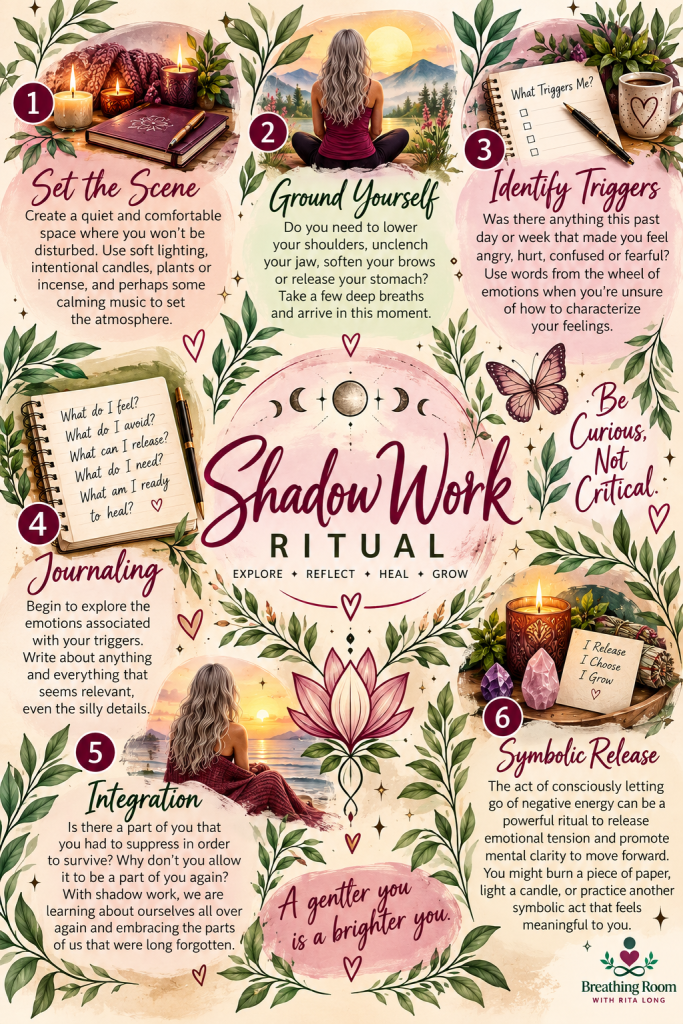
Creating Your Own Shadow Work Ritual
A ritual doesn’t need to be complicated or mystical. At its simplest, a ritual is intentional time that you set aside for yourself.
Choose a quiet place where you feel comfortable and are unlikely to be interrupted. You might dim the lights, play soft instrumental music, light a candle, or simply sit somewhere peaceful.
Bring a journal and pen. If meaningful objects such as crystals, tarot or affirmation cards help you feel reflective, you can include them too. They aren’t necessary for shadow work—the important part is creating an environment where you feel comfortable being honest with yourself.
Before beginning, decide what you would like to explore.
Your intention might be:
“I want to understand why this situation keeps upsetting me.”
“I want to explore why I have difficulty setting boundaries.”
“I want to understand a pattern I keep repeating.”
You don’t have to solve everything in one sitting. One question is enough.
Begin by Grounding Yourself
Before turning inward, spend a few moments settling your body and mind.
Place your feet comfortably on the floor. Relax your shoulders. Take several slow, comfortable breaths and notice the physical sensations around you—the chair supporting you, the temperature of the room, or the sounds you can hear.
You aren’t trying to force yourself into a particular emotional state. You’re simply giving yourself a moment to arrive.
When you feel ready, open your journal.
Let Curiosity Lead the Writing
Shadow work isn’t about finding the “correct” answer. Allow yourself to write without worrying about grammar, spelling, or whether your thoughts make perfect sense.
You might begin with questions such as:
What qualities in other people tend to trigger or irritate me? Why might those qualities affect me so strongly?
What feelings do I have difficulty admitting or expressing?
What parts of myself do I try hardest to hide from other people?
When have I behaved in a way that didn’t match my values? What was happening beneath the surface at the time?
What am I afraid people would think about me if they knew everything I thought or felt?
What did I learn growing up about which emotions were acceptable and which weren’t?
Where in my life am I pretending that something doesn’t bother me when it actually does?
Don’t rush to explain, justify, or fix what appears on the page.
Notice it.
Sometimes awareness itself is the first meaningful change.
Make Room for Uncomfortable Emotions
Shadow work can bring up emotions we would rather avoid.
If anger appears, notice it.
If sadness appears, acknowledge it.
If embarrassment, jealousy, fear, resentment, or insecurity surfaces, try approaching it with curiosity instead of immediately labeling it as good or bad.
You can ask yourself:
“What might this feeling be trying to tell me?”
An emotion does not automatically define your character, and acknowledging a feeling does not mean you must act on it. It simply means you are allowing yourself to recognize what is present.
And remember—you control the pace.
If reflection begins to feel overwhelming, you can stop. Shadow work isn’t a test of how deeply you can push yourself in one sitting.
Closing the Ritual
Rather than abruptly returning to your day, give yourself a clear ending.
You might close your journal and take several slow breaths. You could light a candle as a symbol of greater awareness or write down one belief, habit, or thought you’re ready to begin releasing.
If you enjoy symbolic rituals, you might tear up that piece of paper or place it somewhere private as a reminder of what you’re working toward. If you choose to burn paper or use candles, use ordinary fire-safety precautions and adult supervision where appropriate.
Then ask yourself one final question:
“What do I understand about myself now that I didn’t understand before?”
You don’t need a profound answer every time.
Sometimes the answer is simply, “I need to think about this some more.”
That counts too.
Give Yourself Time Afterward
Deep reflection can be emotionally tiring, so don’t immediately expect yourself to jump back into everything at full speed.
Drink some water. Stretch. Step outside. Take a walk. Listen to music. Sit quietly for a few minutes. Do something that helps you reconnect with the present moment.
You may even want to revisit your journal a few days later. With a little distance, you might notice patterns or connections that weren’t obvious when you first wrote them.
Shadow Work Is About Integration, Not Perfection
The goal of shadow work isn’t to eliminate every uncomfortable thought or emotion.
It’s to know yourself more completely.
Every person contains contradictions. We can be loving and angry. Confident and insecure. Generous and jealous. Brave and frightened. Understanding these different parts of ourselves gives us more opportunity to decide how we want to respond rather than allowing unconscious patterns to make those decisions for us.
Approached gently, shadow work can become less about asking, “What’s wrong with me?” and more about asking:
“What is this part of me trying to teach me?”
And sometimes that single change in perspective can open the door to greater self-awareness, compassion, and growth.
Take what feels helpful, move at your own pace, and remember that personal reflection doesn’t have to happen all at once. Some parts of ourselves are understood slowly—and that’s okay.