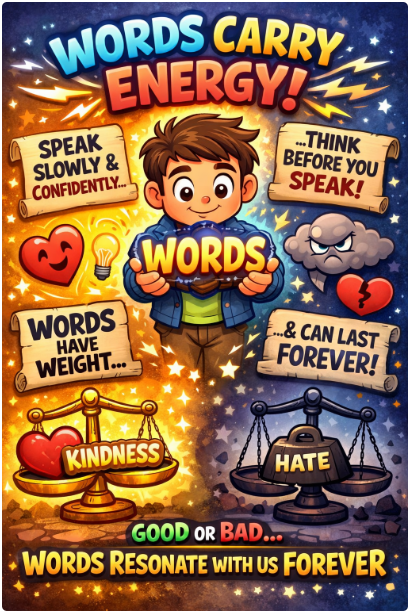
Words are not just sounds or symbols. They are energy — alive, potent, and lasting.
We live in an age of noise. Messages fly at us from every direction — social media, text threads, news feeds, casual conversations. In all of this noise, we’ve somehow convinced ourselves that words are cheap. Throwaway. Easy to take back.
They’re not.
Words carry an energy that most of us severely underestimate. They can lift a person out of the darkest moment of their life, or push someone further into it. They can build decades-long relationships, or shatter them in a single sentence. Long after the moment has passed, long after the person who said them has forgotten they ever spoke — words linger. They echo. They become the voice inside someone’s head.
That’s not a small thing. That’s extraordinary power.
Words Are Energy
Think about a time someone said something genuinely kind to you — not a polite compliment, but something that felt true. Something they didn’t have to say. Chances are, you still remember it. Maybe it came at exactly the right moment. Maybe it changed how you saw yourself.
Now think about a time someone’s words cut you. A criticism delivered carelessly. A comment made in anger. An offhand remark that the speaker probably forgot about before they’d even finished the sentence.
You remember that too, don’t you?
That is the weight of words. They don’t evaporate when the conversation ends. They settle into us. The good ones become quiet fuel — the reason we kept going, kept trying, kept believing in ourselves. The harmful ones can become invisible chains, shaping how we move through the world without us ever realizing it.
Words are not passive. They do something to the people who receive them.
Speak Slowly. Speak Confidently.
There is a quiet power in the person who doesn’t rush their words. Who pauses before they speak. Who seems unbothered by silence. In a world where everyone is in a hurry to be heard, the person who takes their time to speak well commands attention — not because they demand it, but because they’ve earned it.
Speaking slowly signals something important: I’ve thought about this. What I’m saying matters. It gives your listener time to actually receive what you’re saying, rather than simply waiting for their turn to respond. And it gives you the space to say what you actually mean, rather than what comes out in the heat of the moment.
Confidence in speech isn’t about volume. It’s not about having all the answers or never being uncertain. It’s about owning what you say. It’s the difference between “I don’t know, maybe, I could be wrong, but maybe…” and “I’m not sure yet, but here’s what I think.” Both are honest. Only one carries weight.
When you speak with confidence and intention, people listen differently. They lean in. They trust you more. And more importantly — you trust yourself more.
Think Before You Speak
This is perhaps the most radical act in modern life: actually pausing before you respond.
The impulse to react immediately is everywhere. Someone says something provocative, and every instinct fires at once — defend yourself, correct them, prove a point, match their energy. But the words that come out in those moments are rarely the words you actually want to have said. They’re reactive, not intentional. They’re born from the heat of the moment, not from your deeper self.
Thinking before you speak is not hesitation. It’s wisdom. It’s the split second where you ask yourself: Is this true? Is this necessary? Is this kind? What am I actually trying to say — and what will it actually do?
Sometimes the answer is to speak boldly, to say the hard thing that needs to be said. Other times, the most powerful choice is restraint — to let silence do the work instead. Either way, the pause is never wasted. It’s where intention lives.
Words Resonate Forever
A parent tells a child they’re not smart enough. Decades later, that grown adult still hears it in moments of self-doubt.
A teacher tells a struggling student they have something special. Years later, that student — now successful — still thinks of that moment when they needed courage.
We carry our words with us, and we carry the words of others. Some of them we chose. Some were handed to us without our permission. But what we do with the words we give to others — that is entirely in our hands.
The conversation you have today might become the voice in someone’s head tomorrow. The encouragement you offer might be the thing that keeps someone going when everything else tells them to stop. And yes, the careless, unthought remark could be the stone that someone carries for years.
This is not meant to make you afraid to speak. It’s meant to make you intentional about it.
Choose Your Words Like They Matter — Because They Do
You don’t need to be a poet or a philosopher to wield words well. You just need to be present. To slow down. To ask yourself what you actually want to say, and why.
Speak with care. Speak with courage when courage is needed. Speak with kindness when kindness is what the moment calls for. And when in doubt — pause. Think. Let the silence breathe for a moment before you fill it.
Because words, once spoken, belong to the world. They go places you never intended, touch people you’ll never know, and last longer than you’ll ever realize.
Use them well.
“The tongue has no bones, but it is strong enough to break a heart. Be careful with your words.”

Leave a Reply