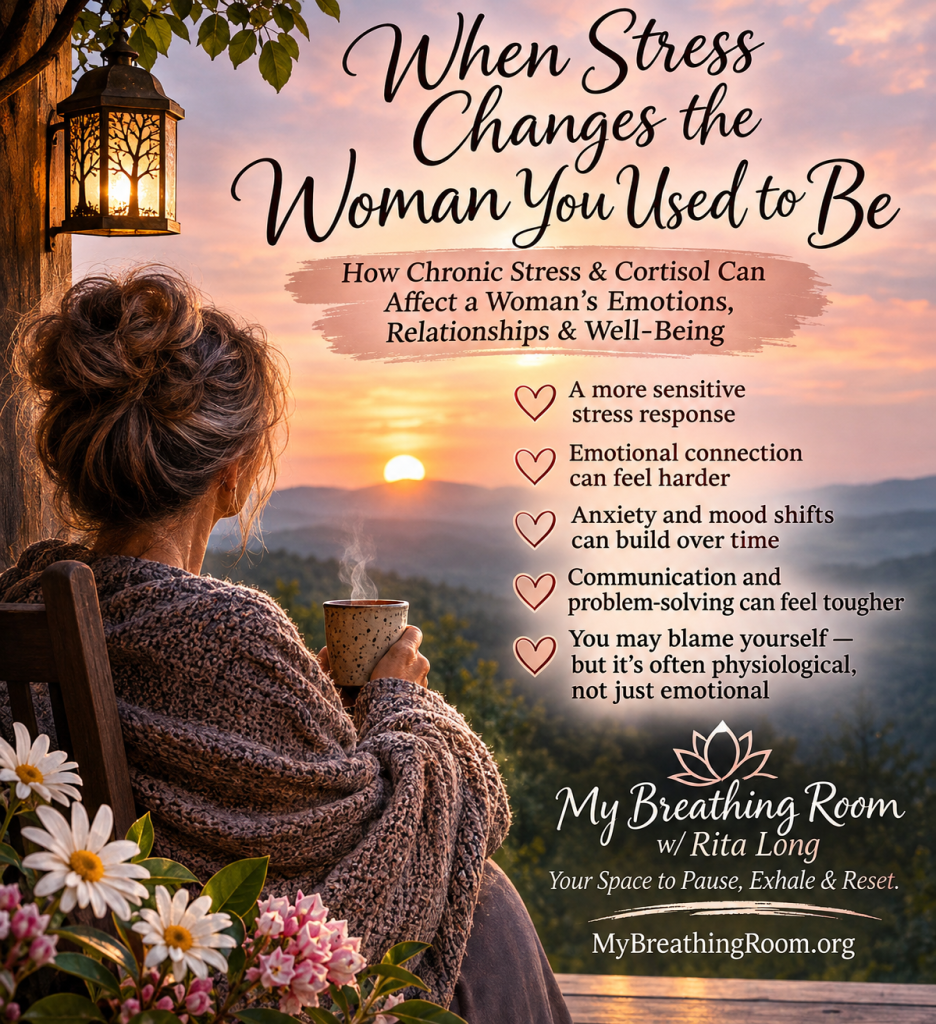
When Stress Changes the Woman You Used to Be
Understanding Cortisol, Emotional Exhaustion, and the Silent Impact of Chronic Stress on Women
By Rita Long | My Breathing Room w/ Rita Long
Have you ever looked at yourself and wondered, “What happened to the woman I used to be?”
Maybe you used to have more patience.
Maybe you laughed more easily, loved more freely, and didn’t feel overwhelmed by the smallest things.
Maybe you were once the person who held everything together, who made sure everyone was taken care of, who kept the peace even when it meant sacrificing your own.
But somewhere along the way, something changed.
You became more easily irritated. You started withdrawing. Things that once rolled off your shoulders suddenly felt unbearable.
Perhaps you even began questioning your relationships, your happiness, or your ability to love the way you once did.
And maybe you’ve been blaming yourself.
But what if some of what you’re experiencing isn’t simply a change in personality?
What if your body has been responding to years of accumulated stress?
Let’s talk about cortisol, the nervous system, and what happens when a woman spends too much of her life carrying more than she can comfortably hold.
1. The Female Stress Response: When Your Body Never Fully Relaxes
Cortisol is often called the stress hormone.
Produced by the adrenal glands, cortisol plays an important role in regulating energy, metabolism, inflammation, and our response to stressful situations.
When we encounter something stressful, our brain activates a communication system called the hypothalamic-pituitary-adrenal axis, or HPA axis.
This system helps prepare the body to respond to challenges.
Our heart rate may increase. Our muscles may tighten. Our attention becomes focused on whatever feels threatening.
This response is natural and necessary.
The problem begins when stress becomes a constant companion.
When you’re repeatedly dealing with arguments, financial worries, emotional uncertainty, caregiving responsibilities, or relationship difficulties, your body may have fewer opportunities to recover.
Research suggests that sex hormones can influence stress responses, although women do not universally produce more cortisol than men.
What matters is that prolonged stress can affect anyone’s physical and emotional well-being.
And for women experiencing perimenopause or menopause, changing estrogen and progesterone levels may add another layer of difficulty.
Sleep disturbances, mood changes, and increased sensitivity to everyday stress can make an already overwhelming situation feel even harder.
You may appear calm on the outside while feeling completely overwhelmed on the inside.
You go to work.
You pay the bills.
You take care of your family.
You smile when someone asks how you’re doing.
But beneath that smile, your body may be carrying tension that never seems to disappear.
And eventually, that tension can begin affecting how you experience the world around you.
2. When Emotional Connection Starts Feeling Like Another Responsibility
One of the most painful effects of chronic stress can be the way it changes our relationships.
Have you ever reached a point where you simply didn’t want anyone touching you, talking to you, or asking you for one more thing?
Not because you stopped loving the people around you.
But because you had absolutely nothing left to give.
Chronic stress can interfere with sleep, emotional regulation, sexual desire, and our capacity to engage with others.
Cortisol also interacts with other hormones and brain systems involved in social bonding, including oxytocin.
But the relationship is complicated. Cortisol does not simply switch off oxytocin or make someone incapable of feeling love.
Instead, ongoing stress can make emotional closeness more difficult to experience.
Imagine spending years feeling responsible for everyone else’s happiness.
You remember the appointments.
You manage the household.
You anticipate everyone’s needs.
You try to prevent arguments.
You choose your words carefully because you don’t know how someone might respond.
Eventually, even affection can begin to feel like another expectation.
Another responsibility.
Another demand.
And when your partner asks why you’ve become distant, you may not even know how to explain it.
Because you remember loving deeply.
You remember wanting closeness.
You remember being affectionate.
But it’s difficult to feel emotionally connected when you’re emotionally exhausted.
This doesn’t mean every relationship problem is caused by hormones.
Sometimes emotional distance is a response to unresolved conflict, repeated disappointment, broken trust, or feeling unsupported.
And those experiences deserve to be acknowledged rather than dismissed as a hormonal problem.
3. When Stress Begins to Look Like a Personality Change
This is where chronic stress becomes especially confusing.
You may begin noticing changes in yourself that you don’t particularly like.
You become impatient.
You react more strongly to situations.
You have trouble sleeping.
You forget things.
You lose interest in activities you once enjoyed.
You feel irritated by conversations that previously wouldn’t have bothered you.
And sometimes, you simply want to be left alone.
You may hear comments such as:
“You’re always in a bad mood.”
“You’ve changed.”
“You’re too sensitive.”
“Why can’t you just let things go?”
But those comments don’t explain what may be happening beneath the surface.
Long-term stress can contribute to anxiety, fatigue, difficulty concentrating, and emotional exhaustion.
Sleep deprivation can make these symptoms even worse.
And during menopause, hormonal fluctuations may affect sleep and mood at the same time.
For some women, the combination can feel overwhelming.
The woman who once had endless patience may now have very little tolerance for unnecessary conflict.
And perhaps that change deserves curiosity rather than criticism.
Sometimes irritability is a sign that we need rest.
Sometimes withdrawal means we’re overwhelmed.
And sometimes our growing unwillingness to tolerate certain behaviors reflects a change in our boundaries, not a problem with our hormones.
There is an important difference between becoming emotionally reactive because of stress and finally recognizing that something in your life needs to change.
Both possibilities deserve attention.
4. Why Chronic Stress Makes Communication and Problem-Solving Harder
Have you ever been in an argument and suddenly found yourself unable to think clearly?
You know what you want to say.
You know what you’re feeling.
But the words won’t come.
Or perhaps you become so overwhelmed that you stop talking altogether.
You withdraw, shut down, or simply walk away.
This can happen because stress affects the brain systems involved in attention, memory, decision-making, and emotional regulation.
During intense stress, our ability to think flexibly and respond thoughtfully may become temporarily reduced.
When stress continues for months or years, concentration and emotional regulation can become ongoing challenges.
This doesn’t mean the brain permanently loses its ability to communicate or feel empathy.
It means that managing stress requires mental and emotional resources.
And when those resources are stretched thin, even ordinary conversations can become difficult.
Consider a woman who has spent the entire day working, managing household responsibilities, worrying about finances, and trying to keep everyone happy.
By evening, she may have very little emotional energy remaining.
Then someone wants to discuss another problem.
Or revisit an old argument.
Or demand an explanation for why she seems unhappy.
And she shuts down.
Not necessarily because she doesn’t care.
But because she is overwhelmed.
Sometimes silence isn’t indifference. Sometimes it’s exhaustion.
Of course, healthy communication remains important.
Stress can help explain someone’s reactions, but it doesn’t excuse cruelty, intimidation, or mistreatment.
Both partners remain responsible for how they treat one another.
And a healthy relationship should make room for difficult conversations without requiring either person to sacrifice their emotional safety.
5. The Most Confusing Part: When You Begin Blaming Yourself
Perhaps the most heartbreaking part of prolonged emotional exhaustion is how easily we begin questioning ourselves.
Why am I so unhappy?
Why can’t I just relax?
Why don’t I feel the way I used to?
Why do little things bother me so much?
Why don’t I want to be affectionate?
Why am I always tired?
Why can’t I make this relationship work?
And eventually, those questions can turn into something even more painful.
What’s wrong with me?
But stress isn’t simply an emotional experience.
It’s also physiological.
It involves hormones, the nervous system, sleep, memory, and the way our brains respond to challenges.
At the same time, our emotional experiences and physical responses are deeply connected.
It isn’t always a matter of choosing between a biological cause and an emotional cause.
Often, both are involved.
For example, a woman experiencing repeated relationship conflict may develop sleep difficulties and ongoing anxiety.
Those physical effects may make her more emotionally reactive.
That increased sensitivity can make conflict harder to manage.
And the cycle continues.
The answer isn’t to blame her body.
And it certainly isn’t to automatically blame her for the difficulties in her relationship.
The answer begins with understanding what she’s experiencing and identifying what needs to change.
What Happens When Menopause Enters the Picture?
For many women, midlife introduces an entirely new dimension to this conversation.
Estrogen levels fluctuate during perimenopause and eventually decline after menopause.
These changes can influence sleep, temperature regulation, mood, and other aspects of physical well-being.
Now imagine navigating those changes while also dealing with:
- Years of accumulated relationship stress.
- Financial responsibilities.
- Aging parents or family caregiving.
- Adult children who still need support.
- Work responsibilities.
- A household that depends heavily on you.
- The emotional weight of feeling unheard or unappreciated.
It’s a lot.
And sometimes the woman everyone describes as having “changed” is simply a woman who has reached the limits of what she can continue carrying.
But here’s something important.
Menopause doesn’t automatically make a woman unreasonable, difficult, or incapable of maintaining a healthy relationship.
And it shouldn’t become an excuse for someone else to dismiss her concerns.
Sometimes menopause makes existing problems harder to ignore.
Sometimes changes in sleep and emotional resilience make ongoing stress more noticeable.
And sometimes midlife brings a clearer understanding of what we want from the years ahead.
More peace.
More honesty.
More connection.
More time for ourselves.
And less emotional turmoil.
That isn’t necessarily a hormonal malfunction.
Sometimes it’s personal growth.
You Cannot Breathe Your Way Out of an Unhealthy Environment
I believe deeply in the power of mindfulness, breathing, meditation, and creating moments of peace.
These practices can help calm the nervous system, reduce perceived stress, and support emotional well-being.
But I also believe something equally important.
You cannot expect a person to remain peaceful while continually exposing them to circumstances that cause distress.
Deep breathing can help regulate your response to stress.
It cannot make another person communicate respectfully.
Meditation can help you become more aware of your emotions.
It cannot repair broken trust by itself.
Mindfulness can help you recognize your needs.
It cannot replace the boundaries necessary to protect your well-being.
Sometimes healing requires more than learning how to relax.
Sometimes it requires changing how we live.
How we communicate.
What responsibilities we accept.
What behaviors we tolerate.
And how much of ourselves we’re willing to sacrifice to maintain peace for everyone else.
Real peace isn’t simply the absence of an argument.
Real peace includes feeling emotionally safe enough to be yourself.
Finding Your Way Back to Yourself
If you’ve recognized yourself in this article, there are gentle ways to begin supporting your nervous system and emotional well-being.
Start by giving yourself permission to acknowledge your exhaustion.
You don’t have to prove how much you’ve carried.
You don’t have to justify needing rest.
And you don’t have to wait until you’re completely overwhelmed before making yourself a priority.
Consider creating small moments throughout your day when nothing is required of you.
Step outside.
Listen to the birds.
Take a slow, comfortable breath.
Relax your shoulders.
Unclench your jaw.
Allow yourself a few moments without solving anyone else’s problems.
Prioritize sleep when possible, and consider speaking with a healthcare professional if anxiety, persistent fatigue, sleep difficulties, or significant mood changes are affecting your daily life.
If you’re navigating menopause, ask about the physical and emotional symptoms you’re experiencing. There may be treatment options that can help.
And perhaps most importantly, examine the sources of stress in your life.
Not everything can be changed overnight.
But some things can change gradually.
You can establish boundaries.
You can ask for help.
You can stop accepting responsibility for everyone’s emotional reactions.
You can recognize that your needs matter, too.
And you can begin making decisions that support the life you want to live.
A Final Thought: Maybe You Haven’t Lost Yourself
Maybe the woman you used to be isn’t gone.
Maybe she’s tired.
Maybe she’s spent years putting herself last.
Maybe she’s been so busy surviving everyday responsibilities that she hasn’t had the opportunity to truly enjoy her life.
Maybe she’s been waiting for someone to recognize how much she’s carrying.
Or perhaps she’s finally beginning to recognize it herself.
Whatever the reason, you deserve the opportunity to understand what you’re feeling without immediately judging yourself.
You deserve rest.
You deserve compassion.
You deserve relationships built on mutual respect.
And you deserve a life that includes moments of genuine peace.
You don’t have to become the woman you used to be.
Maybe the next chapter is about becoming a woman who understands her needs, honors her boundaries, and no longer believes she must exhaust herself to be worthy of love.
Sometimes finding yourself isn’t about going backward.
It’s about discovering who you are when you finally give yourself room to breathe.
Take a Moment for Yourself
Before you move on with your day, ask yourself three questions:
What has been weighing on me lately?
What am I carrying that doesn’t have to be mine alone?
What is one small thing I can do today to create more peace in my life?
You don’t need to have all the answers right now.
Sometimes awareness is where healing begins.
Pause. Exhale. Reset.
My Breathing Room w/ Rita Long
Your Space to Pause, Exhale & Reset.
MyBreathingRoom.org
Disclaimer: This article is intended for educational and personal reflection purposes. It is not a substitute for medical or mental health advice. Stress responses vary between individuals, and persistent symptoms should be discussed with a qualified healthcare professional.

Leave a Reply